
VBC contract growth is outpacing the operating model
Explore why every payer reports value-based care contract growth while operational readiness lags behind.




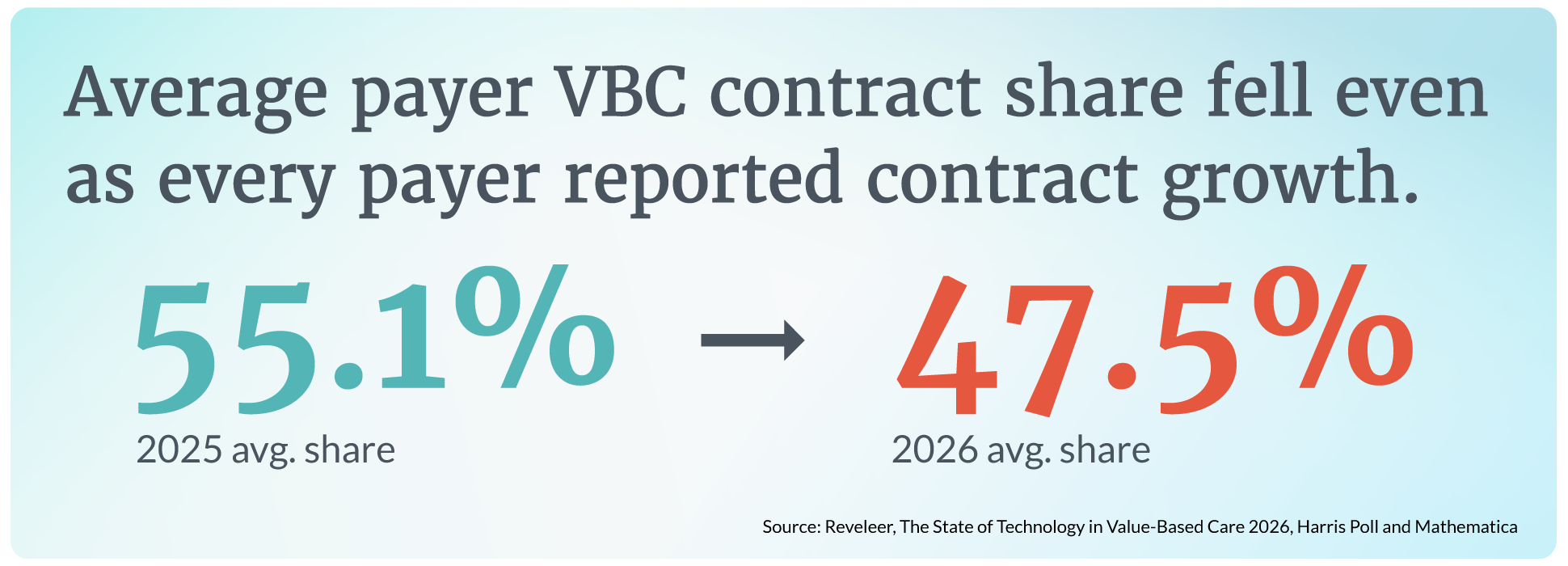
Payers and providers keep signing more value-based care (VBC) contracts. Every payer in Reveleer's 2026 State of Technology in Value-Based Care Report reported contract growth over the past twelve months. The average share of their business running on VBC fell anyway, from 55.1% to 47.5%.
Both figures describe the same payers over the same twelve-month period. Execution capacity is the binding constraint on VBC performance in 2026, ahead of contract volume. The two metrics are often conflated, and distinguishing between them clarifies why both trends can occur in the same year.
Contract growth and contract share measure different things
These two metrics are easy to mix up, though the underlying trend depends on keeping them distinct.
A payer can post growth on one metric while the other moves in reverse, in the same year. For example, a hypothetical payer might run 40 VBC contracts on a $2 billion book of business, with VBC accounting for half of it. The payer then signs 10 more VBC contracts, bringing the total to 50 VBC contracts, a 25% increase in contract volume. If the overall book of business grows too, through new fee-for-service membership or other non-VBC lines, the VBC share of that larger book can still fall, even though the payer's contract count only grew.
Reveleer's 2026 State of Technology in Value-Based Care report exposed this pattern of conflicting volume versus share. Every payer surveyed reported VBC contract growth over the past twelve months, and 99% expect that growth to continue, including 43% who anticipate significant expansion. Providers reported similar momentum: 95% experienced contract growth, up from 81% in the 2025 survey. Contract volume climbed across the board. Contract share still fell, from 55.1% to 47.5%. Payers rely more heavily now on fee for service contracts to deliver revenue than they did in 2025.
Neither number is wrong. Volume counts how many deals get signed. Share measures how much of the business actually runs on the VBC model. Volume improved and share worsened in 2026, for the same organizations.
Signing a new VBC contract has become easier than scaling the operating model required to run it. Organizations are expanding commitments faster than they are expanding the infrastructure, staffing, and workflow capacity needed to convert those commitments into a larger share of managed business. A payer that adds contracts without adding capacity defers the cost of scale. The shortfall tends to surface at the least convenient moment, during an audit cycle or a renewal negotiation, when CMS, providers, and the board are watching most closely.
Alignment erodes first where operating strain surfaces
Payer-provider alignment on VBC goals moved in the opposite direction of contract growth. Most payers, 95% versus 97% in 2025, continued to report strong alignment with providers. Provider agreement fell from 100% in 2025 to 88% in 2026, a 12-point decline concentrated on the side of the relationship that absorbs the operational burden of each new contract at the point of care.
Alignment breaks down at the point of execution, before contracts ever get signed. Providers feel the strain first because prospective risk capture, quality gap closure, and documentation review all run through provider workflows before a payer ever sees the resulting data.
The erosion in alignment also shows up in compliance exposure. CMS's expanded Risk Adjustment Data Validation (RADV) program already covers roughly 550 Payment Year 2020 contracts, and audit review reconstructs exactly the workflows where alignment is fraying, prospective risk capture, quality gap closure, and documentation review. Disconnected systems and inconsistent handoffs between payer and provider leave those records more exposed under review.
The shortfall touches every workflow, all year
The shortfall outlasts a staffing surge during open enrollment or a temporary vendor add, because contract growth touches every stage of the VBC lifecycle at once. Each new contract adds volume across prospective risk capture, retrospective coding, quality gap closure, chart retrieval, submissions, and member enrollment simultaneously. A team verifies eligibility and captures prospective risk before the encounter closes. A coding team completes retrospective coding after the encounter closes. A quality team closes gaps against HEDIS and Star measures. A retrieval team pulls the supporting chart. A submissions team validates the resulting file against CMS and payer specifications. An enrollment team processes the member's election, eligibility, and disenrollment status. One contract touches all six of those functions, and each one absorbs its share of the added volume once the contract takes effect. When staffing increases for one function without corresponding increases across the other five, the backlog shifts to whichever function remains under-resourced.
Vendor breadth beats another point solution
Many organizations respond to VBC growth by adding a separate vendor for each function: prospective risk, retrospective coding, quality abstraction, and member enrollment. Each addition solves a narrow problem and creates a wider one, because reconciling data and workflows across separate vendor relationships consumes the same capacity that contract growth already strains. Each additional vendor also carries its own renewal cycle, support model, and audit trail, expanding what a compliance team has to defend. Health plans that convert contract growth into performance tend to run the full lifecycle through a single vendor relationship.
Signing a VBC contract is the easy part now. Building the operating capacity to run it, across risk, quality, retrieval, submissions, and enrollment, is where health plans are actually being tested."
— Natalie Schibell, MPH, VP, Product Marketing, Reveleer
Four questions worth asking before the next VBC contract
Revenue and membership projections usually drive the decision to sign a new VBC contract. Four operating model questions deserve the same scrutiny, and each is answerable before signature.
- Do the added labor hours across risk, quality, retrieval, submissions, and enrollment workflows fit within current staffing?
- Does the current operating model absorb that volume while keeping review timelines and rework steady?
- Is data reconciliation across the vendor systems involved manageable before this contract's results are audit-ready?
- Is there a plan if this contract arrives alongside several others in the same renewal cycle?
A payer that can answer all four is scaling the operating model along with the book of business.
Reveleer aligns capacity with contract growth
Reveleer gives health plans breadth across the value-based care lifecycle, spanning prospective risk adjustment, quality gap closure, retrospective risk adjustment, chart retrieval, risk submissions, risk analytics, a clinical data repository, and member enrollment, through one vendor relationship. EVE™, Reveleer's proprietary AI layer, powers diagnosis detection, suspect scoring, and workflow prioritization across each function, carrying capacity forward from one program into the next as health plans add contracts.
Consolidating the lifecycle under one vendor changes the operating equation described earlier. A health plan running Reveleer's retrospective risk adjustment program already has coders trained on EVE's evidence layer, a defensible audit trail, and a submissions workflow built to CMS specifications. Extending into prospective risk capture or quality gap closure adds volume to systems and staff already calibrated to the work. A new point solution would start that calibration over. The results below follow the same lifecycle functions outlined earlier:
- Prospective risk capture. Reveleer's point-of-care suspecting solution delivered 6x ROI and $18.5 million in enhanced revenue capture for one health system's Medicare Advantage and Medicare Shared Savings Program population.
- Retrospective coding. One regional health plan used Reveleer's Risk Adjustment suite to code 1.2 million charts in four months, tripling its coding speed.
- Quality gap closure. A multi-state Medicare Advantage payer serving about 100,000 members used Reveleer Care Gap Manager to increase revenue by 14% and lift Star Ratings from a 3.0-3.5 baseline.
- Chart retrieval. Reveleer's AI-enabled retrieval processes records up to 80% faster than traditional methods, freeing clinical documentation staff for higher-value review.
- Member enrollment. Reveleer Member Enrollment automates 90% of enrollment workflows and 95% of member correspondence.
The next audit cycle or enrollment period will show whether a payer's operating capacity matches its contract volume. Waiting for an audit finding to raise that question is the more expensive way to find out.
To learn where your own operating model has room before the next contract cycle, speak with a value-based care strategist at Reveleer.

FAQs
Why is VBC contract growth outpacing the operating model?
Reveleer's 2026 State of Technology in Value-Based Care report found the average share of payer business tied to VBC fell from 55.1% to 47.5%, even as every payer reported contract growth. Contract volume is climbing faster than the staffing and workflow capacity needed to run each new contract.
Which operating capacity should a payer evaluate before signing a VBC contract?
A payer should size the added labor hours across risk, quality, retrieval, submissions, and enrollment workflows, then confirm the current team can absorb that volume while keeping review timelines steady. A contract that requires reconciling data across additional vendor systems carries a real cost beyond the labor hours.
Which functions are most likely to become bottlenecks?
Retrospective coding and chart retrieval carry the widest range of outcomes across health plans, because both depend on documentation arriving from providers in usable form. When contract volume rises faster than staffing in either function, review timelines extend and coding backlogs build ahead of submission deadlines.
When does vendor consolidation make operational sense?
Vendor consolidation pays off once a health plan is reconciling data across three or more systems to close out a single contract. At that point, the time spent matching records and resolving discrepancies between vendors starts to rival the time spent on the underlying work.

About the Author

Related Resources

The ROI of AI-enabled prospective risk adjustment
Learn how AI-enabled prospective risk adjustment drives better clinical outcomes, reduces costs, and improves value-based care.

Ethical AI in value-based care: Balancing innovation with trust and transparency
Watch the session, ‘Ethical AI in Value-Based Care’, to learn about Reveleer’s AI trust and transparency.

Simplifying HEDIS®: How intelligent automation gives you more time
Learn how intelligent automation accelerates HEDIS reporting, improves efficiency, and enhances data accuracy for healthcare organizations.

