Centralize chart data across your enterprise

Eliminate redundant chart retrieval and reuse charts across multiple projects
Upload a record once and reuse it across risk adjustment, quality improvement, RADV, IVA, and care management with Reveleer Clinical Data Repository. Every chart is indexed, searchable, and ready to support your value-based care programs the moment it’s needed.

Eliminate duplicate chart retrieval
Improve operational efficiency and reduce storage duplication with one chart version per member, regardless of how many chases or projects it supports.

Reduce provider abrasion
Consolidate and coordinate chart requests to optimize retrieval requests to providers that contribute to a single source of truth.

Improve audit-readiness
Easier and faster access to charts is made possible with the ability to search by member, provider, group, and dates of service.
How It Works
Load once, use everywhere: Steps to a single source of truth
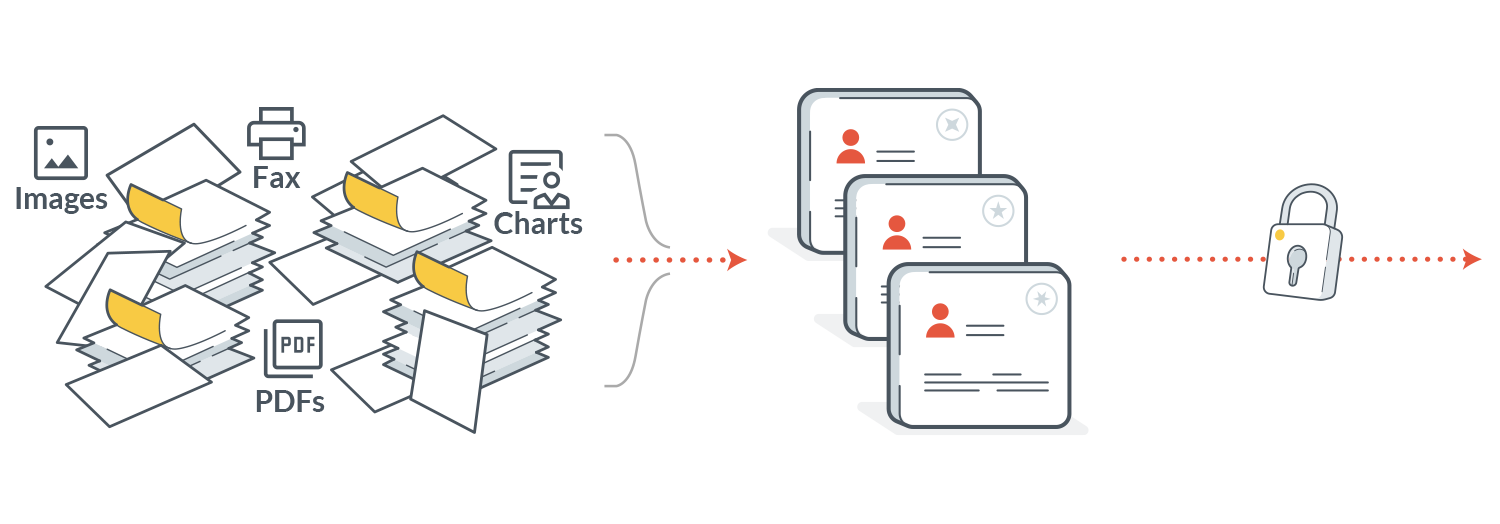
Unify claims and clinical data
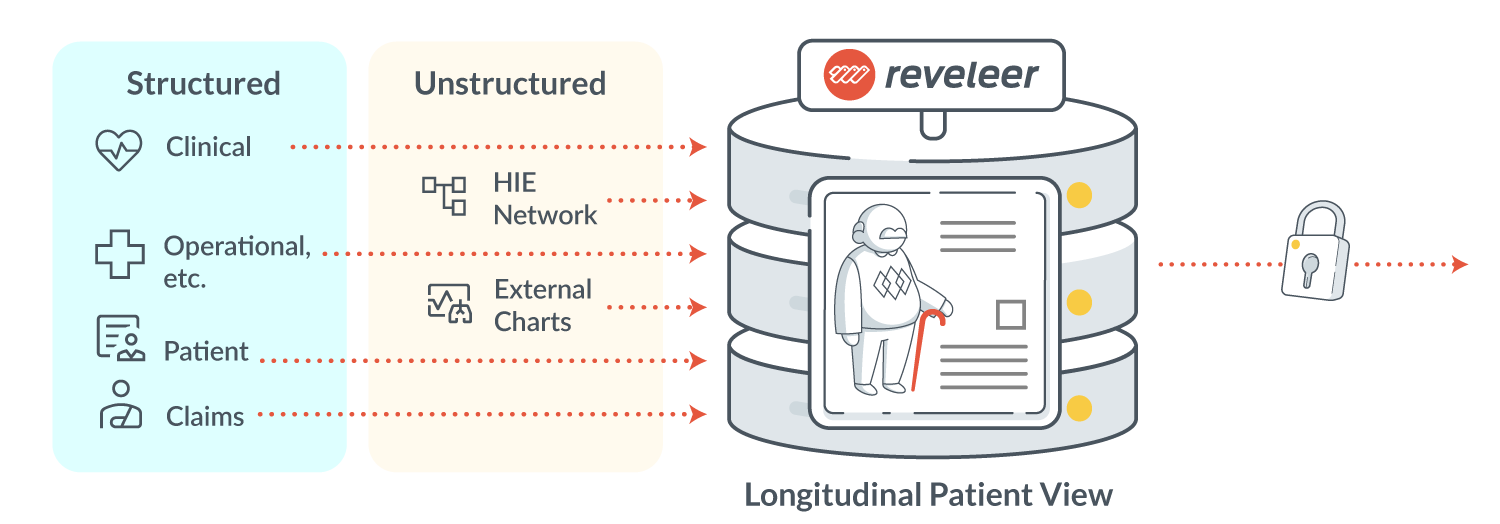
Reveleer ingests structured and unstructured data from EHRs, HIEs, labs, claims, and specialty networks to build a longitudinal patient record.
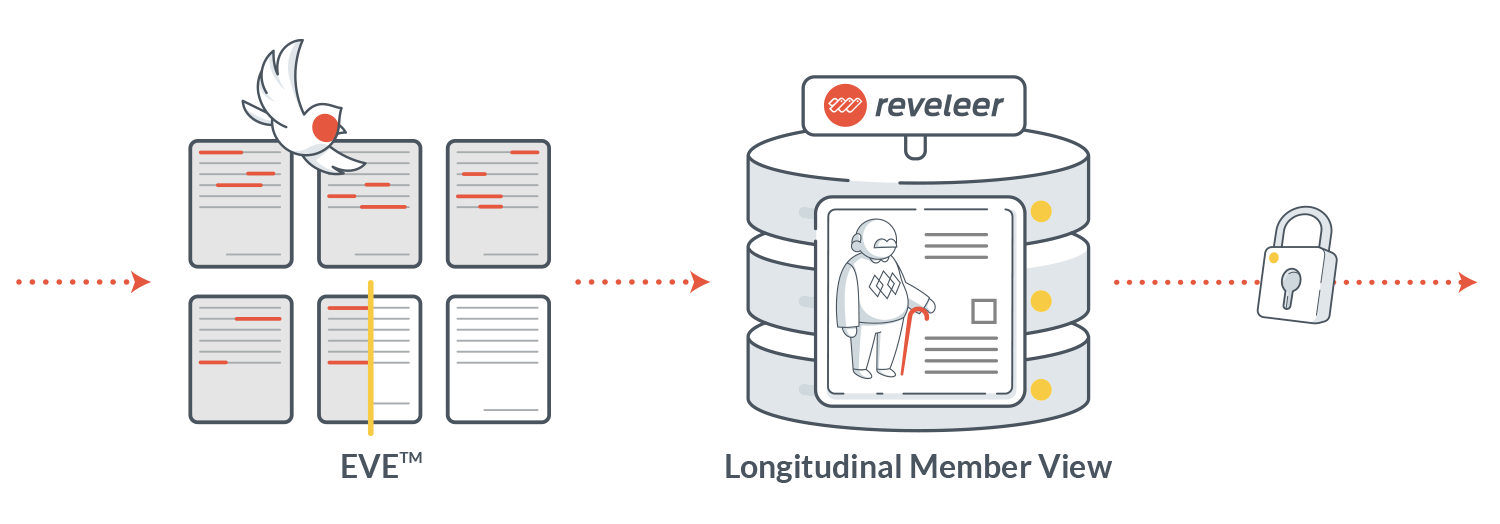
Find high-value opportunities
EVE TM Hybrid AI extracts evidence from charts. Clinician-authored formulas then determine conditions that qualify as potential recapture, net new diagnoses, or open care gaps.
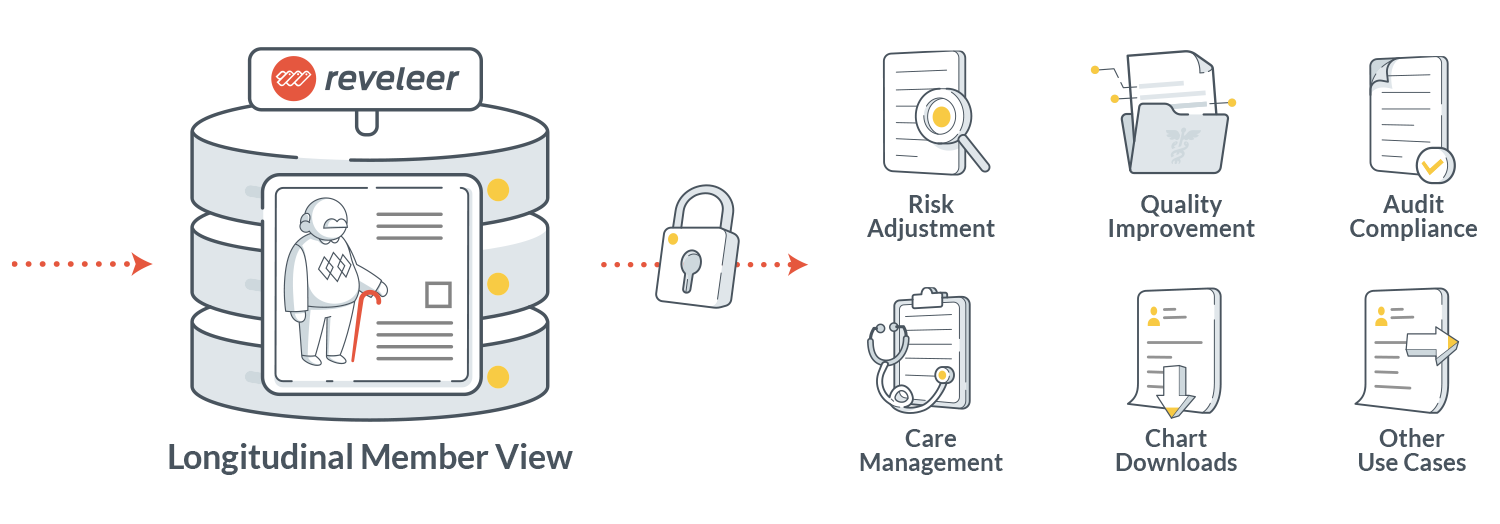
Deliver insights directly in your workflows
CDI teams review prioritized worklists to close diagnosis and care gaps before, during, and after the visit, all supported by advanced analytics.
.svg)
See how connected clinical data drives better performance
Reveleer Clinical Data Repository gives healthcare organizations a single, member-based repository for medical charts. Get a more complete, reliable view of member data to support risk adjustment, quality improvement, and audit compliance priorities while easing the burden on providers.
A Clinical Data Repository with all the capabilities you need

Integrates with your existing ecosystem
Reveleer Clinical Data Repository integrates with EHRs, HIEs, retrieval vendors, and internal data warehouses to produce a data-rich source of truth. Teams can import and export charts via SFTP or API to connect data for multiple programs and power analytics,audit preparedness, and other use cases.
Protects sensitive data with enterprise-grade security
Reveleer applies HIPAA and HITRUST-aligned controls across its platform, with detailed audit trails for chart access and movement. Role-based permissions safeguard PHI while still giving authorized users fast access to the documentation required for their programs.


Powers new value-based care programs
Clinical Data Repository is an enterprise-class, member-based repository of medical charts that are uploaded once then reused across risk adjustment, quality improvement, and care management workflows. The clinical asset can be used to identify care gaps faster, support population health and quality improvement programs, and feed future AI and predictive models with cleaner, more complete clinical inputs.
Common questions about Clinical Data Repository
How is Reveleer Clinical Data Repository software different from traditional chart storage?
Reveleer Clinical Data Repository stores member charts in a unified view so member data, charts,and clinical documentation can be reused across multiple lines of business and teams. Healthcare teams such as risk adjustment, quality improvement, audit compliance, and care management can access the same member view instead of using fragmented data and duplicate charts for individual projects or workflows.
What is the difference between Clinical Data Repository vs data warehouse?
A data warehouse is built to store data types from multiple systems for the purpose of large-scale analytics, reporting, and business intelligence. Reveleer Clinical Data Repository streamlines the chart retrieval process and centralizes patient charts and clinical documentation so risk adjustment, quality improvement, and coding teams can quickly access relevant evidence for care and program workflows. Clinical Data Repository enables faster access to charts via search on member, provider, group, and dates of service, improving audit support and clinical decision workflows.
What file types can I store in Reveleer Clinical Data Repository?
Plans can store PDFs, images, and XML documents, consolidating charts from retrieval campaigns, EMRs, HIEs, as well as unsolicited provider submissions.
How does AI support chart intake and enrichment?
AI helps automatically assign charts to the correct member and capture metadata like provider,group, and dates of service, improving searchability and reuse.
What are the benefits and use cases of Reveleer Clinical Data Repository?
Clinical Data Repository serves as the central chart repository that all Reveleer risk adjustment,quality improvement, and retrieval products can use. Charts that are uploaded can be reused across multiple lines of business, internal teams, and workflows.
How long does Reveleer Prospective Risk Adjustment implementation typically take?
Depending on data readiness and delivery method, prospective risk programs can go live in as little as six to twelve weeks after production data is available, with options for portal access, direct EHR integration, or overlays.
What human oversight exists for the AI-enabled components of Reveleer Clinical Data Repository?
AI and NLP enrichment focus on capturing member and chart metadata to improve searchability and reuse, but the enrichment scope, data quality, and performance expectations are defined upfront. Reveleer customers have clear control over how AI is applied to their chart data and can easily incorporate human oversight into their workflows.
Related Resources
Explore the latest on how AI-enabled prospective risk drives improved outcomes and time-saving efficiency for value-based healthcare organizations.

The ROI of AI-enabled prospective risk adjustment
Learn how AI-enabled prospective risk adjustment drives better clinical outcomes, reduces costs, and improves value-based care.

Ethical AI in value-based care: Balancing innovation with trust and transparency
Watch the session, ‘Ethical AI in Value-Based Care’, to learn about Reveleer’s AI trust and transparency.

Simplifying HEDIS®: How intelligent automation gives you more time
Learn how intelligent automation accelerates HEDIS reporting, improves efficiency, and enhances data accuracy for healthcare organizations.

