
VBC data integration scores high, but quality is the top barrier
Connected systems don't guarantee trusted records. See why data quality tops the value-based care integration barrier list.




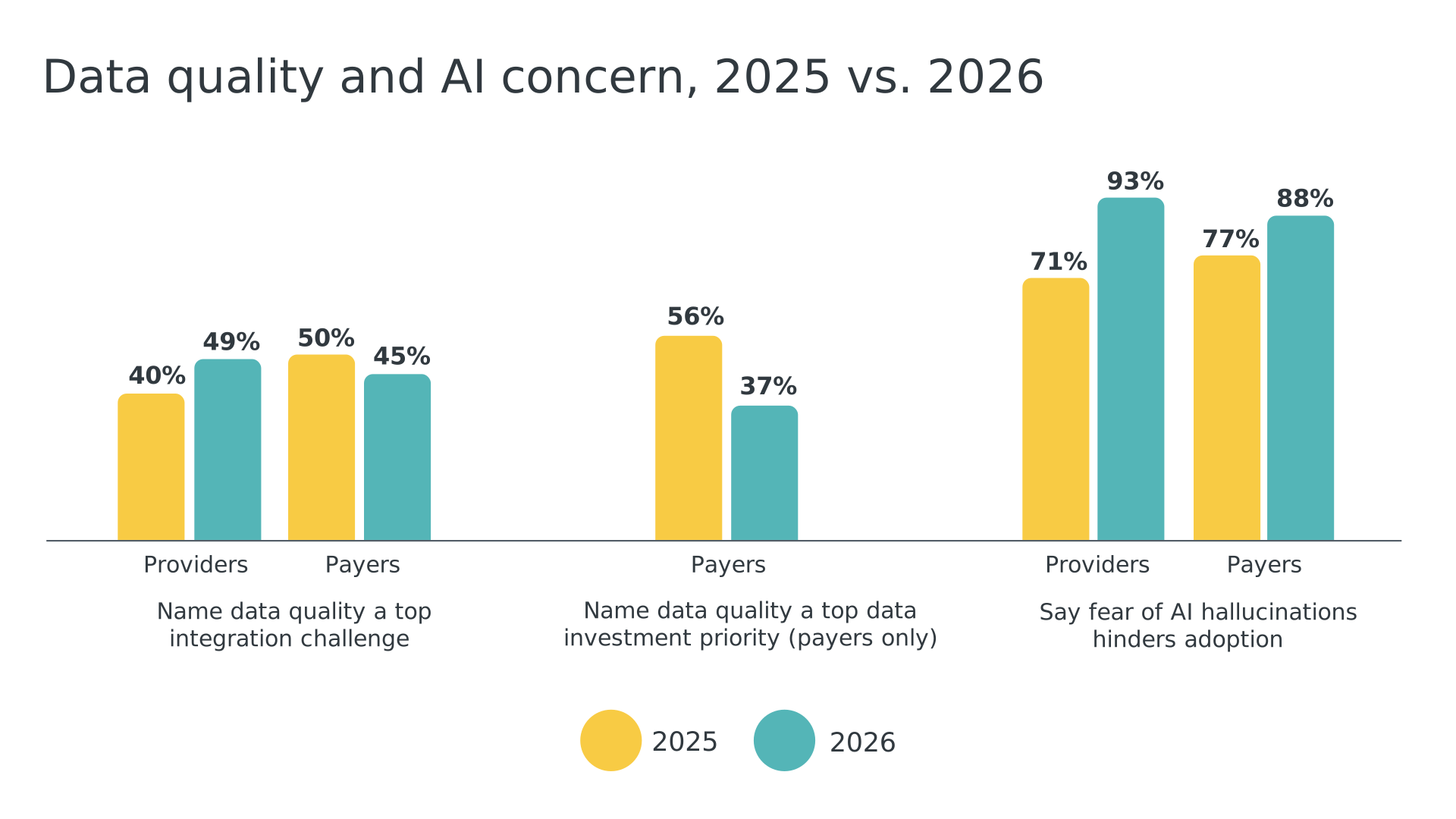
Ninety-five percent of organizations in Reveleer's 2026 State of Technology in Value-Based Care report rate their ability to integrate data across systems as good or excellent. Data quality still ranks as the top integration barrier, cited by 49% of providers and 45% of payers. Both findings describe the same survey year. For value-based care (VBC) organizations, the integration problem now centers on whether connected data is accurate and complete.
A connected system and a trusted record are separate conditions
A health plan can receive a working feed from every provider and still submit diagnoses lacking chart support. An integration rating describes the connection between systems. Data quality describes whether each record crossing the connection is complete, accurate, and tied to a source document. Three metrics tracked in both the 2025 and 2026 surveys, charted below, show where the two diverge.
In 2025, 33% of providers and 31% of payers rated their data integration excellent. The 2026 figure combines good and excellent responses, a broader threshold. The 2025 survey also found only 46% of providers and 53% of payers were very confident in the accuracy and completeness of their patient data. Between 2025 and 2026, data security replaced data quality as the top payer investment priority, with data quality dropping from 56% to 37%. Self-reported ratings describe leader perception. Audited data performance is a separate measure.
Audit expansion turns data quality into a financial exposure
In May 2025, CMS announced it would conduct Risk Adjustment Data Validation (RADV) audits on all eligible Medicare Advantage contracts each year, roughly 550 contracts compared with about 60 previously, and would grow its medical coder workforce from 40 to approximately 2,000. CMS described the plan as a response to a backlog of audits for payment years 2018 through 2024. The agency has since notified Medicare Advantage organizations of payment year 2020 audits on March 20, 2026, payment year 2021 audits on May 29, and payment year 2024 audits on August 28.
Each audit tests whether enrollee medical records support the diagnoses a plan submitted. Only 29% of providers and 13% of payers describe themselves as well-prepared for current CMS policy. Each record moving between systems needs a link to its source document before an auditor, or the plan, can verify it.
AI output inherits the quality of the records behind it
Fear of AI hallucinations hinders adoption for 93% of providers and 88% of payers. Only 35% of organizations have a documented process for catching incorrect AI output. A model reads the data it receives. When the incoming data is incomplete or inconsistent, a reviewer returns to the source chart to confirm each output. The reviewer repeats the manual work automation was adopted to reduce. Because the survey measures leader perception, a causal link between data quality and these AI outcomes remains a hypothesis.
CMS audits apply the same check of output against source. The agency's technology flags diagnoses appearing to lack support before its coders verify each flag against the medical record. A plan preparing for the review needs the same evidence its own coders use, a retrievable chart linked to every submitted diagnosis.
“The next dollar of data investment belongs in source traceability. When a RADV auditor opens a contract, the first question is whether the chart behind each submitted diagnosis exists.”
- Natalie Schibell, MPH, VP, Product Marketing, Reveleer
Four measurements separating data quality from integration
Interface counts and uptime measure data transmission between systems. Four measurements show whether teams can use the data received.
- Of the diagnoses and quality-measure results submitted, what share links to a retrievable source document?
- For each provider and data source feeding the member record, what share of expected encounters and fields is received complete?
- How many members carry duplicate or conflicting records across systems, and who resolves each conflict?
- Who reviews AI-generated suggested diagnoses before submission, and how are reviewer corrections recorded?
Data quality in practice, traced through one diagnosis
A data quality program starts where the chart enters the plan. Health plans retrieve the same records an estimated 2.5 times each year, requesting a chart once for risk adjustment and again for quality or audit work. Reveleer Chart Retrieval acquires each chart through electronic health record (EHR) access, fax, SFTP, or a secure upload portal and indexes it to the member's record in the Clinical Data Repository. When a quality gap opens for the same member months later, the abstraction team works from the indexed chart. Plans reusing charts this way often reduce retrieval effort by 30% to 60%.
The same chart anchors the coding decision. EVE™ surfaces suggested diagnoses and highlights the supporting evidence on the chart page, linking each suggestion to its source document as the first measurement requires. A coder confirms each suggestion against the source before submission. Reveleer Retrospective Risk Adjustment records the basis for every decision as a Validation Reason Code, giving compliance teams the diagnosis-level review record the fourth measurement calls for.
Build the evidence trail before the audit notice arrives
Duplicate member identities, the subject of the third measurement, resolve in the Clinical Data Repository before they split a member's history across systems. At submission, Reveleer Risk Submissions applies CMS rules-based validation to encounter and claims data, flags errors at the file and record level, and reconciles inbound files to surface gaps in record counts, the completeness check the second measurement describes. The product also processes CMS response files to track accepted, rejected, and resubmitted records across submission cycles.
When an auditor asks for support, the evidence trail extends from the submitted diagnosis back to the retrieved chart, the same evidence CMS coders check against each flagged diagnosis. For plans with an active RADV audit, the MA RADV Audit extension to Reveleer Retrospective Risk Adjustment manages the audit sample, scores supporting evidence, and builds the submission package.
Traceability also gives back the hours once spent gathering evidence. Coders spend review time confirming clinical judgment, abstraction staff work from charts already on file, and compliance teams start an audit response from records already indexed to the member.
A plan can take all four measurements inside its connected systems today. To find out how much of your documentation risk traces back to data quality, speak with a value-based care strategist at Reveleer.
FAQs
Why do health plans and providers rate their data integration highly but still cite data quality as a barrier?
Reveleer's 2026 State of Technology in Value-Based Care report found 95% of organizations rate their cross-system data integration as good or excellent, while 49% of providers and 45% of payers name data quality as the leading integration challenge. Integration describes whether systems exchange data. Data quality describes whether the exchanged data is complete, accurate, and supported by a source document.
What is the difference between data integration and data quality?
Data integration measures whether systems connect and exchange records. Data quality measures whether the exchanged records are complete, accurate, free of duplicates, and traceable to a source document. An organization can rate high on the first and low on the second, which the 2026 survey data suggests for both providers and payers.
How does data quality affect RADV audit readiness?
Risk Adjustment Data Validation (RADV) audits test whether the medical record supports each submitted diagnosis. CMS intends to conduct them on all eligible Medicare Advantage contracts each year. Only 29% of providers and 13% of payers describe themselves as well-prepared for current CMS policy. An auditor can verify a diagnosis only when it traces to a retrievable source document.
What should a health plan measure to track data quality?
A health plan can track the share of submitted diagnoses and quality-measure results linked to a retrievable source document, the completeness of each data feed, the rate of duplicate or conflicting member records, and the documented review of AI-generated output before submission.

About the Author

Related Resources

The ROI of AI-enabled prospective risk adjustment
Learn how AI-enabled prospective risk adjustment drives better clinical outcomes, reduces costs, and improves value-based care.

Ethical AI in value-based care: Balancing innovation with trust and transparency
Watch the session, ‘Ethical AI in Value-Based Care’, to learn about Reveleer’s AI trust and transparency.

Simplifying HEDIS®: How intelligent automation gives you more time
Learn how intelligent automation accelerates HEDIS reporting, improves efficiency, and enhances data accuracy for healthcare organizations.

