
VBC contract growth is outpacing the operating model
Explore why technology adoption stopped being the constraint on value-based care performance in 2026.




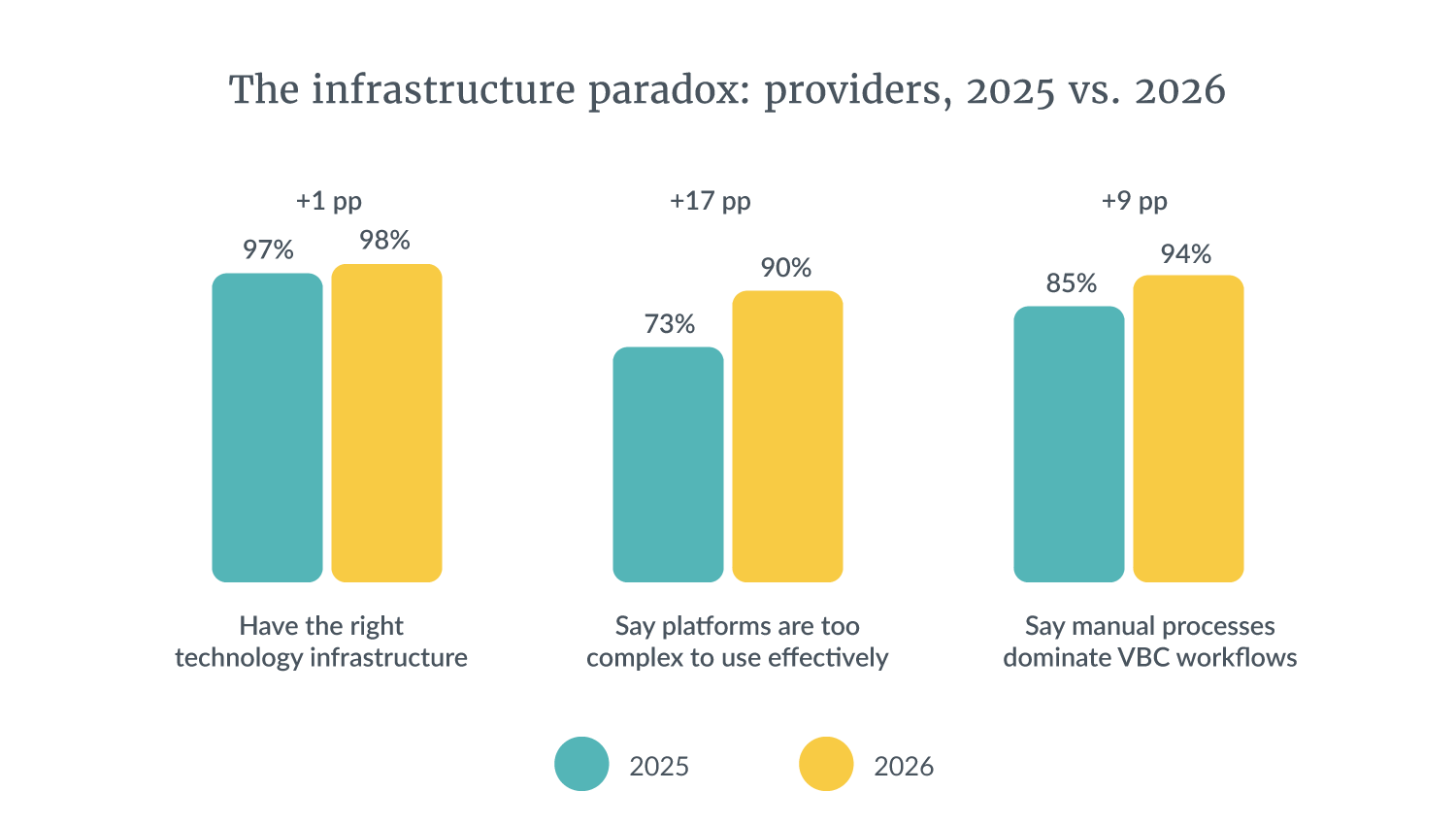
Ninety-eight percent of providers in Reveleer's 2026 State of Technology in Value-Based Care Report say they have the right technology infrastructure to run value-based care (VBC). Ninety percent of those same providers say their platforms are too complex to use effectively, up from 73% in 2025. Both figures describe the same providers in the same survey year. Workflow automation is the constraint on VBC performance in 2026. Technology adoption already cleared that bar.
Infrastructure and workflow automation measure different things
A health plan can have the right systems in place and still run every step around those systems by hand. The 2026 survey data separates the two conditions clearly for providers, and the gap between them widened over the past year. Three provider metrics tracked across both survey years show where that divergence sits.
The infrastructure line barely moved. The complexity and manual-process lines moved sharply, in the direction that erodes the value of the infrastructure investment. A provider organization that installs a new diagnosis-suspecting platform has changed its technology. Whether a coder still copies output into a spreadsheet, routes it by email, and reassembles evidence by hand before submission is a separate question, and 2026's data says the answer is usually yes.
Payers report the same pattern. Reveleer's 2026 report found 85% of payers calling their platforms too complex for effective use, up from 75% in 2025, and 91% saying manual processes still dominate their VBC workflows. The infrastructure paradox runs on both sides of the contract.
The workflow strain traces back to trust
Trust, more than technical capability, determines which workflows an organization automates. Reveleer's 2026 report ties this directly to governance and data quality. Teams automate the workflows they trust, and trust depends on clean, defensible data behind the output.
Trust erodes further when a health plan adds vendors ahead of consolidating the data governance behind them. Reveleer's 2026 report found data silos increased 19 percentage points among providers between 2025 and 2026, and 93% of organizations now agree that AI vendors have overpromised on their ability to support VBC performance. A new platform adds a system to reconcile against the others, leaving both problems in place.
Independent data outside Reveleer's survey points to the same pattern. CAQH's 2025 Index, covering more than 600 health plans and provider organizations across 63% of insured lives, found a $21 billion savings opportunity remains from converting manual and partially electronic administrative transactions into fully automated workflows, even after more than a decade of measured progress industry-wide.
Point solutions multiply systems more often than they multiply automation
A health plan facing platform complexity often responds by adding a more specialized system for the function causing the most friction, such as a standalone quality abstraction tool, a separate submissions engine, or a dedicated enrollment platform. Each addition can solve a narrow problem while making the workflow harder to operate, because staff now reconcile output across a longer chain of systems before a chart, chase, or file is ready to submit.
Each additional system also brings its own login, audit trail, and support relationship. The manual assembly work just shifts to a different seam between systems.
Ninety-eight percent of providers say the technology is in place, and ninety percent call it too complex to use. The split between those two numbers settles which question matters more this year. Health plans have already answered whether they invested. Whether the investment ever left the shelf is the question still open."
— Natalie Schibell, MPH, VP, Product Marketing, Reveleer
Four questions worth asking before the next platform purchase
A demo answers whether a system can perform a task. Whether staff run that task automatically or by hand only becomes clear six months after go-live. Four questions surface the difference before the contract is signed.
- Does this system automate the actual daily steps, or does it hand off a result that still requires manual routing, review, and reassembly?
- How many separate screens, spreadsheets, or systems does a staff member touch to take one chart, chase, or file from start to finish today, and does this purchase reduce or add to that count?
- What evidence does the vendor provide that a comparable health plan's workflow changed after implementation, beyond what the technology stack alone demonstrates
- What is the documented process for catching and correcting an automated output before it reaches a coder, a provider, or CMS?
A health plan that can answer all four before signature is buying automation. A health plan still gathering answers is buying another system to reconcile.
One workflow, one system to reconcile
Follow one chart through a health plan running Reveleer. Reveleer's retrieval technology pulls the chart once from the EHR, HIE, fax line, or provider portal it originates in, extracting clinical evidence at speeds up to 96,000 pages per hour, and indexes it to the member's record in the Clinical Data Repository, where every downstream program pulls from the same file. When a quality gap opens on the same member months later, the abstraction team pulls that same indexed chart from the Clinical Data Repository, skipping a second request to the provider and cutting retrieval effort by 30% to 60%.
EVE™ surfaces MEAT-supported diagnosis evidence tied to that same documentation, so the coder opens a case with HCC suspects and supporting evidence already attached, work that previously started from a blank chart. Reveleer's Risk Adjustment solution improves overall RAF capture by 33% and saves an average of 1,100 hours across a program. A CMS MARx transaction later updates the same member's eligibility or enrollment status, and Reveleer Member Enrollment automates 90% of enrollment workflows and 95% of member correspondence, posting that update directly to the member record and closing out what was previously a manual entry task in a separate system.
Four separate point solutions in that sequence would each need their own login, their own export, and their own reconciliation step before the next team could use the output. Reveleer maintains one chart ID, one evidence packet, and one audit trail across all four steps.
Redeploying the staff hours that workflow used to consume follows from this automation. Coders spend more time on judgment calls and less time on data entry. Retrieval staff spend less time chasing duplicate records. Enrollment staff spend more time handling exceptions and less time on routine transactions.
Where automation stops and manual reassembly begins inside systems already purchased is worth auditing directly. Platform complexity traces more often to workflow design than to the underlying system, and the fix costs less before an audit cycle forces the question than after it does. To find out how much of your own platform complexity traces back to workflow, speak with a value-based care strategist at Reveleer.

FAQs
Why do health plans have the technology for VBC but still run manual workflows?
Reveleer's 2026 State of Technology in Value-Based Care report found that 98% of providers report having the right technology infrastructure, but 90% say their platforms are too complex to use effectively, up from 73% in 2025. Installing a system changes the technology available. The steps staff perform by hand around that system change on a separate timeline, one that requires its own deliberate rebuild.
What is the difference between technology adoption and workflow automation?
Technology adoption measures whether the right systems are in place. Workflow automation measures whether the processes running through those systems run automatically, apart from manual routing, review, or reassembly. A health plan can score high on the first and low on the second, which is what 2026's survey data shows across payers and providers.
Does adding another point solution reduce platform complexity?
Usually the opposite. A new point solution solves the narrow problem it was bought for while adding a system that staff must reconcile against every other system already in place. Reveleer’s 2026 report found data silos increased 19 percentage points among providers between 2025 and 2026, tracking the same period platform complexity rose.
What should a health plan evaluate before buying new VBC technology?
A health plan should confirm the vendor can show a comparable customer's workflow changed after implementation, beyond how the technology performed in a demo. Counting how many separate systems a single chart, chase, or file passes through today, and whether the purchase reduces or adds to that count, surfaces the workflow question before signature.

About the Author

Related Resources

The ROI of AI-enabled prospective risk adjustment
Learn how AI-enabled prospective risk adjustment drives better clinical outcomes, reduces costs, and improves value-based care.

Ethical AI in value-based care: Balancing innovation with trust and transparency
Watch the session, ‘Ethical AI in Value-Based Care’, to learn about Reveleer’s AI trust and transparency.

Simplifying HEDIS®: How intelligent automation gives you more time
Learn how intelligent automation accelerates HEDIS reporting, improves efficiency, and enhances data accuracy for healthcare organizations.

