
10 questions to ask any AI vendor in value-based care before you sign
Use these 10 questions to evaluate value-based care AI vendors on accuracy at scale, human review, and governance.




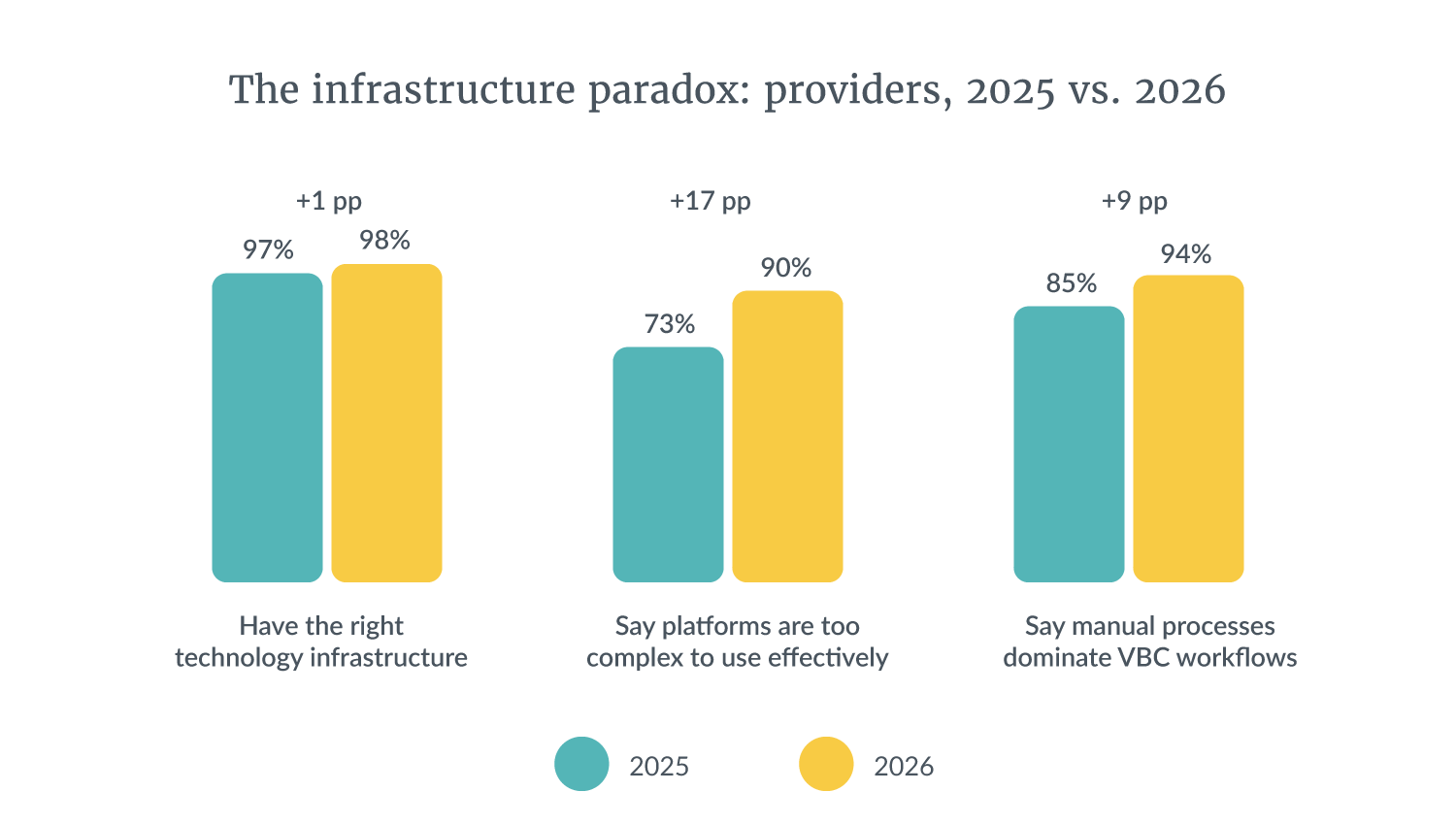
A model that performs well on a 500-chart pilot and slows down at 50,000 charts a month never faced a real test. Health plans and providers find this out after they add new value-based care contracts, exactly when accuracy and throughput matter most. Reveleer's 2026 State of Tech in Value-Based Care report surveyed payers and providers already using AI in production. The results show a wide gap between stated readiness and daily reality. 98% of providers say they have the right technology infrastructure for value-based care, yet 94% say manual processes still dominate their workflows.
Health plans pay for that manual work in time and money long after a contract is signed. The ten questions below come directly from what payers and providers told us in the report. Ask every AI vendor these questions before you sign a contract, including Reveleer.
The ten questions at a glance
- How does the AI perform at your actual Medicare Advantage contract volume?
- What changes for your coders and clinicians during chart review?
- Where does automation stop and clinical human review begin in diagnosis coding?
- What is the code capture and HEDIS® impact by day 90?
- What is the clinical evidence chain behind every AI-suggested diagnosis?
- How does the vendor treat clinical data security as a parallel investment priority?
- What is the documented process that catches incorrect AI-suggested diagnoses?
- What is the acceptance rate on AI-suggested diagnoses your coders review today?
- How fast can the AI reproduce RADV audit evidence for a two-year-old diagnosis?
- What governance framework adapts as CMS rules and AI models change?
1. How does the AI perform at your actual Medicare Advantage contract volume?
Request accuracy and throughput numbers broken out by volume tier, from a comparable deployment, validated against a defined baseline. The vendor should also state the average page count per chart and the density of clinical content per page in that deployment. A 40-page chart with sparse notes and a 400-page chart with dense specialist records are different workloads. Throughput figures mean little without that context. A demo number from a controlled environment reflects the vendor's showcase conditions. A volume-tiered result from a comparable deployment reflects conditions close to your own contracts. Ask for that number before you sign.
2. What changes for your coders and clinicians during chart review?
Manual work still dominates value-based care workflows for 94% of providers and 91% of payers, according to the report. Provider reliance on manual work rose nine percentage points year over year. A model that looks strong in a demo and fades once it reaches production often fails here, because the AI's output follows a different sequence than the coder's or clinician's own workflow. Request a walkthrough of one chart review from start to finish, with each workflow change named up front. The detail in that walkthrough should match the impact the vendor claims.
3. Where does automation stop and clinical human review begin in diagnosis coding?
58% of providers and 48% of payers in the report say they worry about AI decisions made without adequate human oversight. A defensible answer draws the line task by task, as in the table below. A real boundary names what the AI decides and what staff decides, separately and explicitly.
4. What is the code capture and HEDIS impact by day 90?
Every clear, valid condition missed in the chart leaves the member's RAF score below what the clinical record supports. A lower score means a lower CMS payment for that member. Plans rated four stars or higher in the Medicare Star Ratings qualify for a CMS quality bonus that raises their payment benchmark by 5 percentage points. KFF estimates the bonus averaged $372 per enrollee in 2025. A vendor's commitment should name a measurable improvement in complete and accurate code capture, HEDIS gap closure, or chart review time within the first 90 days. Your own team should define, in advance, the day-90 evidence that would show the program delivers a financial return as well as an operational one.
5. What is the clinical evidence chain behind every AI-suggested diagnosis?
Fear of AI hallucinations slows adoption for 93% of providers and 88% of payers, according to the report. The remedy is a vendor that shows where each output came from. A complete answer traces every AI-suggested diagnosis back to its source system (EHR, claims feed, HIE, or lab system) and shows how the data became a standard clinical indicator. Your team should also be able to retrieve that evidence on demand. Ask for proof that the cited evidence supports the diagnosis, and how often it does not. When your compliance team asks where a specific suspect came from, the answer should take seconds.
When your compliance team asks where a specific suspect came from, the answer should take seconds. A vendor without that trail hands you weeks of reconstruction work instead.
— Jay Ackerman, CEO & President, Reveleer
6. How does the vendor treat clinical data security as a parallel investment priority?
98% of payers in the report affirm that real-time data access matters for proactive care management, but only 29% name it as a top investment priority, a 69-percentage-point gap between what leaders say matters and what they fund. Data security ranks first among payers' data investment priorities in 2026, even though its share slipped seven points year over year, from 49% to 42%. Data quality investment fell further, from 56% to 37%. A credible answer covers HITRUST certification, end-to-end encryption, real-time data access, and a documented data quality standard, all four together. A vendor that moves fast with clinical data but lacks any one of the four creates the exposure the report measures.
7. What is the documented process that catches incorrect AI-suggested diagnoses?
Every organization in the report already uses AI, yet only 35% have a documented process for detecting an incorrect output. A vendor should be able to identify and correct an incorrect AI-suggested diagnosis or quality data element before it reaches a coder or clinician. Its methodology should include ongoing fairness monitoring across model performance, version-controlled logic updates that are documented and traceable, and a clear escalation path when confidence is low. A program that only adds diagnoses and never removes unsupported ones draws auditor scrutiny regardless of its accuracy score.
8. What is the acceptance rate on AI-suggested diagnoses your coders review today?
93% of payer and provider organizations in the report agree AI vendors have overpromised on their ability to support value-based care performance, up 11 points from last year. A feature list describes what a platform can do in theory. The acceptance rate on the AI suggestions your team reviews today, and the date that number was last measured, show what it does in production. A vendor that cannot produce a recent, measured rate is asking you to rely on the feature list.
9. How fast can the AI reproduce RADV audit evidence for a two-year-old diagnosis?
Payment Year 2020 RADV audits began in February 2026 across roughly 550 Medicare Advantage contracts, as CMS moves toward auditing every eligible contract each payment year, with new audits launching about every three months. Only 13% of payers in the report describe themselves as well-prepared for the current CMS audit cadence. Any AI vendor should produce, on demand, the specific page in the original chart a diagnosis was drawn from, the lab value or clinical finding that supported it, and the date of the encounter tied to that evidence. The real test is how long it would take your team to produce that same chain for a diagnosis submitted two years ago, for one contract selected tomorrow.
10. What governance framework adapts as CMS rules and AI models change?
68% of payers and 74% of providers in the report now rely on third-party AI vendors to support value-based care. Multi-vendor AI stacks assembled during the 2023–2024 adoption surge are now generating reconciliation hours and documentation gaps that surface under audit. A governance framework worth trusting traces every suggestion back to specific source evidence, monitors performance for drift and bias on an ongoing basis, and version-controls clinical logic so updates deploy without retraining the entire model.
The stakes are too high for general answers
Every one of these questions has a specific, verifiable answer. A general one asks you to take the vendor at its word. Reveleer built EVE™ with an answer to each of these ten questions, including accuracy and throughput validated at volume, a governed boundary between automation and clinical judgment, a documented evidence chain traceable to source in seconds, and a two-way review standard that adds and removes diagnoses with equal discipline.CMS is moving toward auditing every eligible Medicare Advantage contract every year. Your next AI vendor evaluation should assume an auditor is already looking over your shoulder.

Which questions matter most for your role
Every buyer in this evaluation has a different stake in the answer. A CIO weighs scale and security first. For a CMIO, clinical workflow fit comes first, while a VP of Risk Adjustment looks hardest at the evidence chain behind a RAF submission. The table below maps each role to the questions to prioritize, drawn from the same 2026 State of Tech in Value-Based Care findings.
HEDIS® is a registered trademark of the National Committee for Quality Assurance (NCQA).
A CIO checking throughput, a CMIO checking workflow fit, and a VP of Risk Adjustment checking the evidence chain end up asking the same question in different words. Can the vendor show its work, or only describe it?
— Jay Ackerman, CEO & President, Reveleer

About the Author

Related Resources

The ROI of AI-enabled prospective risk adjustment
Learn how AI-enabled prospective risk adjustment drives better clinical outcomes, reduces costs, and improves value-based care.

Ethical AI in value-based care: Balancing innovation with trust and transparency
Watch the session, ‘Ethical AI in Value-Based Care’, to learn about Reveleer’s AI trust and transparency.

Simplifying HEDIS®: How intelligent automation gives you more time
Learn how intelligent automation accelerates HEDIS reporting, improves efficiency, and enhances data accuracy for healthcare organizations.

