
Agentic AI for ACO risk adjustment needs a defensibility standard
Learn how agentic AI with clinician oversight and audit trails is necessary to maintain compliance under CMS scrutiny.




Agentic AI has become a dependency for ACO risk adjustment. Benchmarks, risk score caps, and audit standards each attach financial consequences to documented diagnoses, and manual chart review cannot produce that documentation at the pace ACOs need.
Increasing dependence on AI creates audit exposure. In the 2026 State of Technology in Value-Based Care Report, AI adoption reached 100 percent of surveyed payers and providers, yet only 35 percent of organizations have a documented process to catch an incorrect AI output. An agent without a named owner, an evidence trail, and clinician sign-off produces outputs that an ACO must later defend. A defensibility standard, meaning every diagnosis is traceable to clinical evidence and a human reviewer, helps agentic AI strengthen ACO performance and minimizes audit exposure.
NAACOS Fall recap: Participation decisions and AI shared the agenda
Reveleer wrapped up three days in Washington, D.C. at NAACOS Fall 2026 where ACO leaders worked through themes ranging from CJR-X and TEAM to the Rural Health Transformation Program. Sessions covered MSSP and LEAD participation decisions, specialist engagement, behavioral health integration, community care for duals, network design, and enabler partnerships with health systems.
Across tracks, one challenge kept returning: getting data early enough to act on it. Sessions on prospective risk, AI in population health, and quality reporting described ACOs managing prospective risk with retrospective data, working from attributed-population snapshots that are stale on arrival, and finding documentation gaps in clinical notes after the visit has ended.
Quality sessions pointed to health information exchange, TEFCA-based exchange, and FHIR-based digital measures as ways to close gaps sooner. Transitions-of-care and post-acute sessions raised the same problem from another side: fragmented data sharing between hospitals, skilled nursing facilities, and primary care limits what care teams can see in time.
AI arrived as the leading answer to that problem. Some speakers presented AI as a way to extend a care team’s reach: surfacing suspected conditions and care gaps before a visit, handling routine engagement and documentation in the background, and turning contract terms into prioritized action lists.
AI governance remains an open question. ACOs need ways to oversee AI that touches risk scores: who owns accuracy, what evidence each suggestion carries, and how clinician review gets documented. The next step for ACOs is defining that oversight before AI carries more of the documentation workload into the 2027 performance year.
CMS scrutiny reaches ACO risk scores through benchmarks, caps, and audits
CMS keeps raising the accountability ACOs carry, and NAACOS Fall 2026 sessions put that on the agenda. “The Next Decision Point: MSSP, LEAD, and the Financial Road Ahead” weighed participation against risk, reward, and organizational readiness. A panel of CMS leaders took questions on new models and their requirements, and the CJR-X and TEAM session addressed episode-based accountability for cost, quality, and outcomes.
Three CMS policies raise the cost of risk scores an ACO cannot support. Each applies to ACOs differently.
- MSSP benchmarks. CMS released the CY 2027 Physician Fee Schedule proposed rule on July 14, and the comment period closed in September. The Shared Savings Program proposals include risk-adjusting the 5% cap on upward benchmark adjustments, which allows larger adjustments for ACOs serving higher-risk populations. A benchmark that moves with beneficiary complexity makes documentation accuracy a direct input to shared savings.
- ACO REACH and LEAD risk score caps. Risk score caps change what accuracy is worth. In ACO REACH, CMS added an additional 3% cap on risk score growth from 2019 to 2026 for Standard and New Entrant ACOs. LEAD, which begins January 1, also limits risk score growth against a fixed base year. Under caps like these, an ACO cannot catch up later, and an understated baseline can keep limiting its benchmark for years. The only dependable path is a risk score that is complete and supported from the start, with every diagnosis traceable to clinical documentation.
- Medicare Advantage audits. In 2025, CMS announced it would audit all eligible Medicare Advantage contracts for each payment year, about 550 plans compared with roughly sixty a year before, and would deploy systems to review medical records and flag unsupported diagnoses. While this new regulation does not apply to MSSP benchmarks, MA Risk Adjustment Data Validation (MA RADV) applies to the risk adjustment contracts ACOs are engaged in and the documentation that ACO clinicians submit impacts RADV audits and may ultimately impact negotiated rates with MA plans. As regulatory scrutiny intensifies, risk-bearing organizations need confidence that every reported diagnosis is clinically supported, accurately coded, and defensible.
For an ACO, the practical test is the same under all three policies: pick any diagnosis behind a risk score and trace it to a documented clinical encounter, a named reviewer, and the date someone checked it.
State of Technology data shows AI adoption ahead of governance
Earlier this year, Reveleer commissioned the 2026 State of Technology in Value-Based Care Report with The Harris Poll and independent analysis by Mathematica. The findings describe the same operating conditions ACOs described at NAACOS 2026: AI inside risk-bearing contracts, manual workflows underneath it, and rising audit expectations around it.
The numbers describe a readiness gap more than an adoption gap. Reveleer CEO Jay Ackerman framed the consequence: “Regulators don’t review intent. They review records and confirm concrete clinical data.” For an ACO, that standard turns every AI suggestion into a record a reviewer can open, which makes the owner, the evidence, and the approval step part of the product ACOs buy and not an afterthought.
Regulators don’t review intent. They review records and confirm concrete clinical data.
— Jay Ackerman, CEO, Reveleer
Four controls that make agentic risk adjustment defensible
Agentic AI in risk adjustment stays defensible when an ACO governs four things: who owns accuracy, what documentation each diagnosis needs, when validation happens, and how every step is logged.
Manual, retrospective programs struggle most with the third and fourth controls. Chart review that starts after the performance year closes finds problems when correction is no longer possible. An ACO defensibility standard is its ability to substantiate every submitted risk score with traceable evidence, from the source clinical document through the final diagnosis. An ACO that meets it produces the supporting record and the path it traveled when a reviewer asks, instead of reconstructing both under deadline.
Agentic ACO risk adjustment: AI agents prepare the work, and clinicians decide
Using agentic AI in ACO risk adjustment supports the work behind a risk score: retrieving records, assembling evidence, and surfacing suspected conditions for clinician review. Agents absorb the volume, while clinicians and certified coders assess each condition and make every documentation and coding decision. The system logs each step.
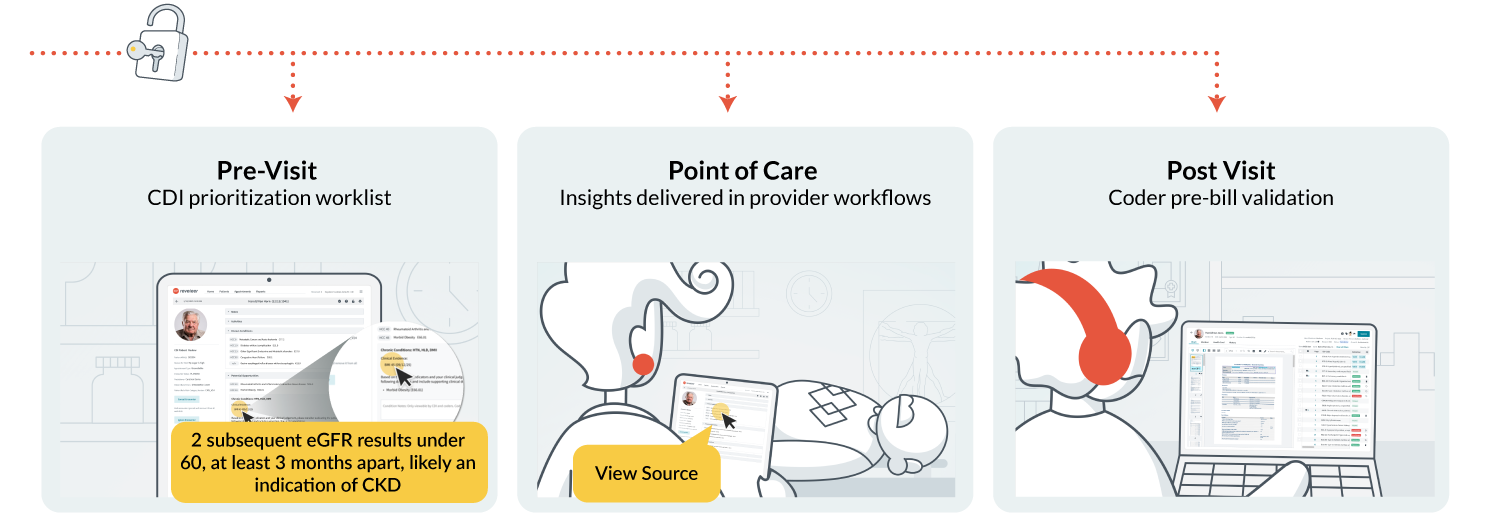
The workflow moves three tasks earlier in the year:
- Before a visit, an agent assembles prior records and flags suspected conditions that lack current-year documentation, allowing CDI specialists to curate the HCC review list prior to the visit.
- During the visit, the provider evaluates each flagged condition and documents what the patient’s exam supports.
- After the visit, an agent checks the record for completeness and routes exceptions to a reviewer before the claim is submitted.
Retrospective review performs the same checks, but only after the visit has closed. Clinician review and evidence links help address concerns about AI errors. Every suggestion arrives with its source in the chart, and no suggestion becomes a diagnosis without clinician confirmation.
Preparing for the 2027 performance year
NAACOS Fall 2026 sent ACO leaders home with decisions to make: MSSP or LEAD, how to prepare for CJR-X and TEAM, and how to get data early enough to close gaps. The AI governance decision sits inside every one of those conversations, making AI policy a critical topic every ACO leader needs to address.
ACOs can start by naming an executive owner for risk score accuracy and give that owner authority to escalate. Then, ACOs should test the four controls against one primary care group by sampling diagnoses and tracing each to its source. Finally, piloting an agentic workflow in that group, with clinician review and a logged trail, can help determine reliability before expanding across the ACO.
Reveleer collects records from disparate sources, surfaces risk adjustment insights before the visit, and routes conditions with source evidence for efficient clinician confirmation, followed by the opportunity for post-visit, pre-bill validation, resulting in a comprehensive prospective risk adjustment process. ACO leaders can speak with a Reveleer expert to see how every suggested diagnosis carries its source evidence, building the clinician trust that AI adoption depends on.

Frequently asked questions
Is agentic AI the same as autonomous coding?
No. Agentic AI completes multi-step preparation work, such as retrieving records and surfacing suspected conditions, but a qualified clinician must document and confirm each diagnosis. Autonomous coding implies no human decision. In risk adjustment, a diagnosis counts only when an acceptable provider documents it during a face-to-face encounter.
Does CMS audit ACO risk scores?
CMS applies risk score controls to ACOs directly through ACO REACH and its successor, LEAD, which cap risk score growth, and through MSSP benchmark methodology. Its RADV audits target Medicare Advantage contracts, not ACO benchmarks. ACO documentation still supports diagnoses in Medicare Advantage submissions, so audit standards shape what ACOs treat as defensible.
What is an ACO defensibility standard?
A defensibility standard is an ACO’s ability to trace every submitted diagnosis from the source clinical document to a documented encounter, a named reviewer, and the date of review.
Is a defensibility standard a CMS requirement?
CMS does not define a formal defensibility standard for ACOs. The term describes the ability to substantiate every submitted risk score with traceable evidence, from the source clinical document through the final diagnosis. ACOs adopt it to withstand benchmark changes, risk score caps, and documentation review, and to supervise any AI used in coding workflows.

About the Author
Related Resources

The ROI of AI-enabled prospective risk adjustment
Learn how AI-enabled prospective risk adjustment drives better clinical outcomes, reduces costs, and improves value-based care.

Ethical AI in value-based care: Balancing innovation with trust and transparency
Watch the session, ‘Ethical AI in Value-Based Care’, to learn about Reveleer’s AI trust and transparency.

Simplifying HEDIS®: How intelligent automation gives you more time
Learn how intelligent automation accelerates HEDIS reporting, improves efficiency, and enhances data accuracy for healthcare organizations.

