
Documented evidence defines defensible ACO risk adjustment
Under the LEAD Model, ACOs need AI insights matched to each role and evidence that survives CMS review.




At NAACOS's Northeast Regional Meeting this month, nearly every session returned to whether AI-predicted diagnoses are meaningfully improving quality and cost performance for accountable care organizations. Jaime Williams, VP of Clinical Informatics at Reveleer, and I examined the question in a fireside chat on where AI adds the most value for ACOs, arriving at a moment when CMS's LEAD Model gives ACOs a 10-year runway to move from reactive coding to proactive care decisions. Reimbursement and network standing under LEAD depend on documentation strong enough to satisfy an audit, the exact stakes ACO executives and CDI leaders now manage.
The data and the technology to pinpoint an ACO's highest-risk patients already exist. The harder task is determining which AI-generated insights to trust, routing them to the right person at the moment they can act, and confirming the result withstands CMS review. The LEAD Model ties accountability for all three to how well organizations can defend their AI-assisted decisions under value-based care.
Fixing fragmented ACO workflows requires coordination across roles
AI has expanded what ACOs can see, surfacing more diagnosis opportunities, longitudinal evidence, and signals pulled from HIEs. During the session, Williams discussed how providers, CDI teams, and coders each work from a different piece of the picture, and only coordinated workflows close the resulting gaps, regardless of how much additional AI output ACOs generate.
CMS's LEAD Model raises the cost of a fragmented workflow. Replacing ACO REACH in January 2027, LEAD runs on a fixed benchmark through 2036, a ten-year window that locks in early documentation decisions for the full cycle. ACOs have to get documentation right the first time, with little room to correct course later. The model also brings in organizations managing risk adjustment for the first time, including smaller rural and independent practices and specialist groups newly added to accountable care, many building risk infrastructure from the ground up.
LEAD changes participation while governance fundamentals stay the same
LEAD changes the ACO rules for who participates and how risk is calculated, while the fundamentals of what makes a program work stay the same. Understanding current workflows in specific detail, matching insight to each role instead of running one workflow for everyone, and building audit-ready governance from day one remain critical. The same session offered a framework for evaluating vendors, centered on whether a technology is adoptable inside existing workflows, whether it is clinically vetted and transparent about how it works and who tested it, and how quickly vendor feedback turns into production changes.
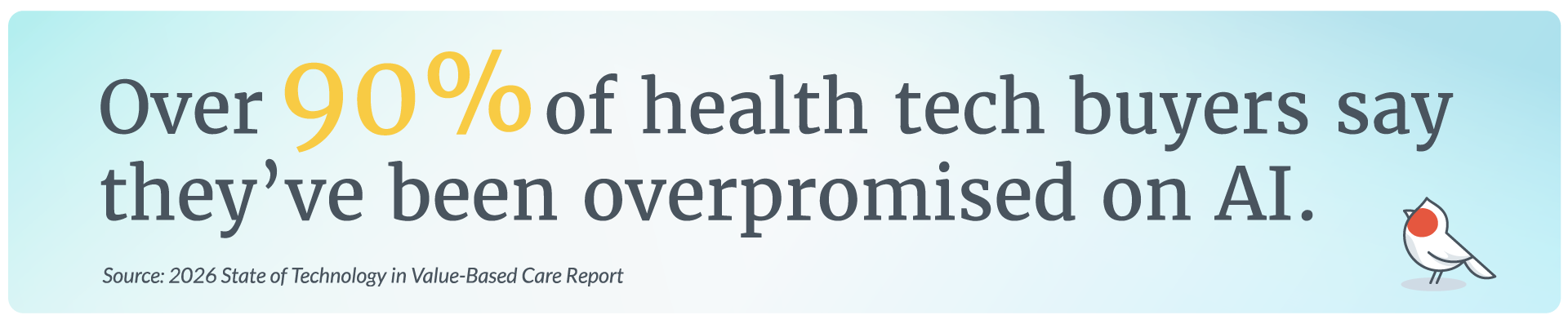
Vendor skepticism at this level is warranted. The 2026 State of Technology in Value-Based Care Report found that more than 90% of buyers felt overpromised by AI and health tech vendors. A 90% overpromise rate is reason enough to press vendors on realistic claims before signing on.
Insight has to match the provider and the visit
By the time an AI-generated insight reaches the provider, it should be clinically meaningful and reduce their workload. After the visit, HCC-trained coders validate documentation, make additions or deletions, and query the provider only when needed.
The right insight for a provider depends on who they are and what the visit is for. A physician with 20 years of HCC experience can work through a longer list in a 15-minute visit; a new resident needs a narrower, more curated one. An annual wellness visit can support a fuller set of gaps; an acute visit for a sinus infection should stay focused on the reason the patient came in.
The Reveleer AI-Enabled Platform lets ACOs configure around this, surfacing only conditions with full certainty, limiting a visit to a single condition, or limiting review to conditions a provider has addressed within the last two years. Clinicians still need a direct role in vetting those configurations before they reach a provider.
Defensible diagnoses require a documented evidence trail
Defensible risk adjustment means every flagged diagnosis can withstand CMS review. Hybrid AI makes that possible through a two-step process. The system handles data acquisition and evidence extraction, while clinician-authored formulas determine which conditions actually reach the provider.
Every condition that reaches a provider links to the specific evidence behind it, whether an outside cardiology note or a record pulled from a connected HIE. The evidence trail helps a provider act quickly at the point of care and gives the ACO documentation it can produce months later if CMS asks for it.
AI is not replacing the human. We need to make sure the human stays in the loop."
— Jaime Williams, VP of Clinical Informatics, Reveleer
The session also flagged four elements ACOs should expect from any AI-enabled risk program, including model versioning, clinical oversight, performance trending, and a full audit trail for everything presented to a provider. MA RADV audits sample a small fraction of charts but extrapolate findings across the full risk pool, so a single unsupported diagnosis can carry outsized financial consequences. With that scrutiny now routine, the governance layer converts an AI-surfaced diagnosis into ACO risk an organization can defend
Other NAACOS Northeast sessions reinforced the same lesson
Reveleer’s session echoed a theme that ran through the entire day in Providence. Rhode Island’s Health Insurance Commissioner, Cory King, used his fireside chat to walk through the AHEAD Model and the regional cost pressures shaping value-based care in the Northeast. NAACOS’s Aisha Pittman covered the new CMMI models and policy shifts ACOs are navigating alongside LEAD.
Later sessions showed the same operational discipline in different clinical settings. MaineHealth’s ACO turned CMS Shadow Bundle data into an interactive analytics platform that got physician leaders across Cardiology, Orthopedics, and Neuroscience actively reviewing high-variation episodes, extending the same “right information to the right person” principle from coding to utilization review. Boston Medical Center’s dialysis transition program combined informatics with community health workers to cut unplanned admissions by 50% and save $1.45 million in total cost of care. Its BREATHE program paired pharmacy-led intervention with predictive analytics to get ahead of COPD and asthma penalties.
Different clinical problems pointed to the same underlying lesson. AI and analytics produce results only when they reach the right person, inside a workflow built to act on them, backed by evidence that survives review.
Documented evidence becomes the standard under LEAD
As LEAD widens who is expected to manage ACO risk well, the organizations that come out ahead will be those that can document why each flagged diagnosis is accurate, evidence-backed, and delivered to the person positioned to act on it. Achieving that consistently, across a ten-year benchmark and a widening field of participants, now requires AI at scale. The same standard applies as much to a rural independent practice managing risk for the first time as it does to a health system with a decade of HCC experience. Under LEAD, the ACOs that build evidence into infrastructure from day one will be the ones still standing when the ten-year benchmark closes.


About the Author

Related Resources

The ROI of AI-enabled prospective risk adjustment
Learn how AI-enabled prospective risk adjustment drives better clinical outcomes, reduces costs, and improves value-based care.

Ethical AI in value-based care: Balancing innovation with trust and transparency
Watch the session, ‘Ethical AI in Value-Based Care’, to learn about Reveleer’s AI trust and transparency.

Simplifying HEDIS®: How intelligent automation gives you more time
Learn how intelligent automation accelerates HEDIS reporting, improves efficiency, and enhances data accuracy for healthcare organizations.

