
Why ACOs can't wait on V28 and RADV readiness
CMS is raising the bar for risk adjustment. Learn why V28 and RADV readiness require a shift from retrospective chart chasing to prospective workflows.




The regulatory environment for Medicare Advantage (MA) and value-based care has shifted in ways that make a prospective approach to risk and quality imperative for ACOs. CMS’s V28 model changes and the expansion of RADV audits to all MA contracts aren’t temporary pressures. They represent a permanent increase in expectations for what accurate, defensible risk and quality data looks like. ACOs that continue to rely on retrospective chart chases and once-a-year HEDIS initiatives are accumulating audit exposure with every passing quarter.
The good news is that the path forward is clear. Prospective risk adjustment and quality improvement supported by clinically-grounded tools and human-in-the-loop artificial intelligence (AI) can help ACOs make the shift to V28 and RADV readiness. This effort amplifies the intent of risk adjustment in that it should drive resources to the patients who need the most care. When the end-to-end process works effectively, providers are able to create comprehensive assessments and clinical action plans needed for patient care and chronic condition stabilization. When ACO leadership across population health, finance, compliance, and operations align around a fundamental different way of working, they can follow CMS signals and improve financial sustainability while improving clinical care, no matter what regulatory changes come their way.
For patients, that looks like shorter waits to see their primary care provider, fewer handoffs, and more time in the room focused on their health (i.e. hypertension, diabetes, COPD, depression, etc.), instead of on paperwork. For providers, it means technology that does the work in the background so they are not spending 27 “virtual” hours a day providing all guideline-recommended preventive, chronic disease, and acute care to a typical patient panel. When risk and quality workflows support this kind of visit, the same infrastructure that protects RAF accuracy also supports better control of chronic conditions over time.
What CMS is signaling: Prospective risk adjustment is no longer optional
The introduction of CMS-HHS V28 has introduced new hierarchical condition category (HCC) exclusions and tighter specificity requirements, demanding more precise and timely documentation. Historically, risk adjustment teams rely on end-of-year chart reviews to catch what was missed at the point of care. However, risk adjustment factor (RAF) forecasting and revenue projections built on retrospective assumptions are increasingly unreliable.
The enhanced RADV audit guidelines increases the stakes. Universal audits across all MA contracts, extended lookback periods, and heightened documentation scrutiny give auditors more runway to find gaps. The financial exposure from audit failure is an operational reality every ACO leadership team needs to price into their risk model.
Finally, the shift toward digital quality measurement and year-round HEDIS strategy are making prospective risk and quality strategies imperative for ACOs. Annual compliance sprints are giving way to continuous data capture requirements. Real-time quality measurement is increasingly intersecting with risk adjustment in ways that make siloed, sequential workflows untenable.
What’s standing in the way of V28 and RADV readiness
Within many ACOs, risk adjustment and quality teams operate in siloes despite relying on the same underlying data. Manual clinical documentation improvement processes are not scalable, and end-of-year chart chases generate provider abrasion without reliably improving documentation accuracy. HEDIS campaigns run on their own calendar, disconnected from the risk adjustment workflow happening across the hall. The impact shows up at the practice level. Primary care clinicians with panels of 2,000 or more patients, seeing 20 to 30 people a day in 15–20 minute blocks, cannot realistically chase down every missing diagnosis or care gap buried in separate portals. The more fragmented the data, the harder it becomes to use each visit to advance long‑term goals like cancer screening, medication titration, and chronic disease control.
Unfortunately, 61 percent of providers believe that value-based care is hurting their practice. Providers are already overburdened with administrative tasks, and adding additional documentation requirements, alerts, and expectations makes the problem worse. Primary care providers often manage a dozen or more managed care contracts, each with unique program requirements . If they are failing to implement prospective strategies, it is because the technology and workflows they have been given were designed for a different environment. It is not that providers are ignoring care gaps or HCCs; they are protecting scarce minutes with patients. When every visit starts with sorting through noisy alerts and reconciling conflicting program rules, there is less time to talk about things like home blood pressure readings, medication side effects, or why a patient has not completed a needed screening.
More alerts are not helping. AI-driven alerts are often noisy and lack the level of precision needed to gain providers' trust and make an impact on patient care. Also, when the alerts are not traceable, providers have no way to make informed decisions based on evidence; not to mention, when audit season rolls around, it becomes more difficult to justify AI-predicted diagnoses. Over time, alert fatigue trains clinicians to click past everything, even when the advisories point to real risks like uncontrolled diabetes, worsening heart failure, or missed cancer screenings. A high‑confidence, clinically relevant signal in a sea of noise is still likely to be ignored, which means patients wait longer for the interventions that could keep them stable and out of the hospital.
Finally, a lack of data integrity and integration makes prospective risk impossible. Things like claims submitted to the wrong payer, HCCs being missed, results that are not documented, and vaccine registry gaps represent systematic leakage that undermines both HEDIS performance and risk adjustment accuracy.
What prospective, clinically grounded workflows look like
The shift from retrospective to prospective risk and quality work isn't about discarding what works. It's about moving the most important work earlier in the care cycle. Successful prospective workflows rest on four interconnected components:
1. Unified data layer
Effective prospective risk and quality starts with aggregating structured, semi-structured, and unstructured data from EHRs, HIEs, claims, and labs into a single longitudinal patient view. Data fragmentation is the enemy of both risk accuracy and quality performance. Without a shared foundation, every downstream workflow is operating with incomplete information, and every gap that gets missed becomes either a missed capture opportunity or an audit liability.
2. Suspecting with hybrid AI
Rather than relying on black-box probability scores that providers do little to gain provider trust, hybrid AI can deliver high-fidelity suspects with traceable clinical evidence. Combining AI with clinical algorithms and human review dramatically improves signal quality.
3. Information delivered to providers
ACO providers need to receive a complete, consolidated view of what each encounter needs to address in advance of the visit: existing diagnoses flagged for recapture, suspect conditions supported by clinical evidence for consideration, and open care gaps spanning HEDIS and other quality measures. Everything should be in one place, across all payers, in a consistent format. That way, providers spend time on clinical decisions, not on hunting down what each program requires. In a 15‑minute visit, that difference is decisive. A single, consolidated view lets the provider focus the conversation on adjusting insulin, ordering a colonoscopy, or addressing rising PHQ‑9 scores, instead of toggling between three systems to piece together what the patient actually needs.
4. Workflow integration
Prospective solutions have to meet providers where they already work. That means pre-visit curation that prepares charts before the encounter, point-of-care EHR advisories that surface the right information at the right moment, and post-visit coding validation that confirms documentation before claims go out the door. The result is audit-ready documentation built as standard practice, not assembled in a scramble during RADV season.
Organizations that have implemented these workflows have seen HCC recapture rates improve by 30 percentage points. This is the difference between a defensible compliance posture and one that depends on last-minute scrambles.
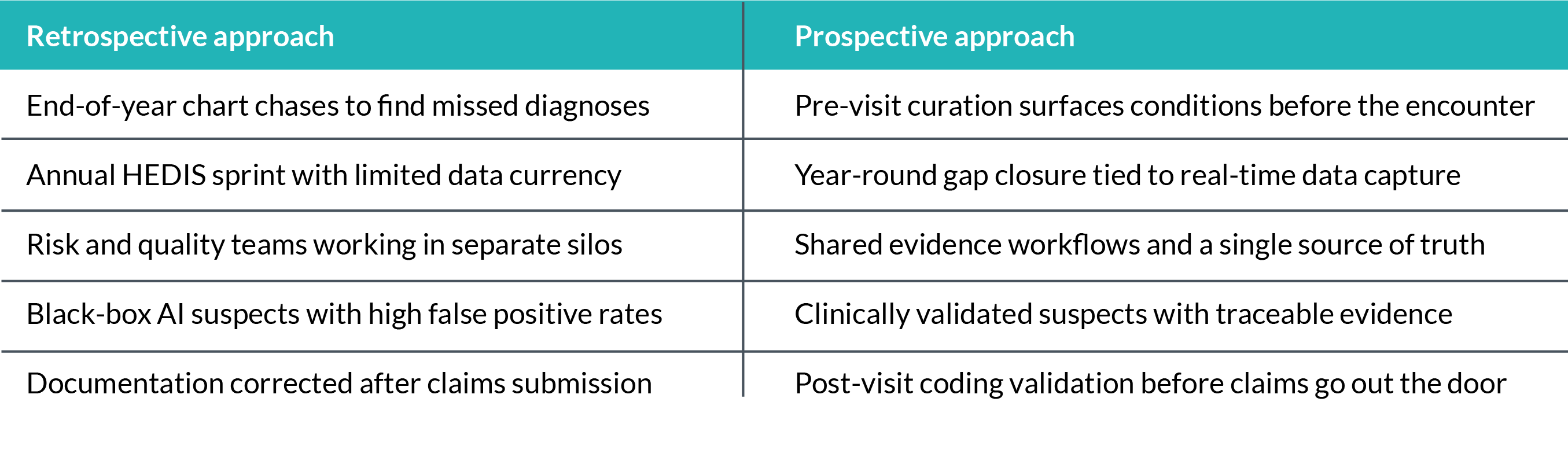
Supporting more accurate documentation at the point of care with human-in-the-loop AI
Reducing provider abrasion is a clinical and financial necessity. Existing technology and workflows, however, often fail to support the level of precision CMS now requires. And layering more requirements on top of broken workflows produces more fatigue, not better outcomes.
The right intervention is a different kind of technology solution. Hybrid models that combine AI with clinical algorithms and human review deliver suspects with traceable clinical evidence, not black-box probability scores that providers don't trust. When a suspect condition arrives with supporting documentation already surfaced, the provider's job becomes the final step of the process instead of a lengthy investigation. That distinction matters enormously at the point of care. It also means the conversation can stay centered on the patient. Instead of silently scrolling through the chart, clinicians can look up, explain why a new diagnosis is being considered, review options, and align on a realistic plan to manage chronic conditions over the coming year.
The data supports it. Organizations using clinically validated suspects have seen false positive rates drop from roughly 80 percent to as low as 2 percent. These solutions generate less noise, better signal, and fewer interruptions to clinical workflow.
The key is that point-of-care advisories must integrate directly into EHR workflows, showing up where providers are already working, in a consistent format across payers. That way, ACOs can eliminate the friction of context-switching and reduce the cognitive load of managing multiple program requirements simultaneously. The goal is accurate documentation the first time, which means providers spend less time on retrospective correction, fewer encounters require follow-up queries, and the documentation that does exist holds up under RADV and HEDIS scrutiny.
When providers trust the technology they are given, they use it. That is how ACOs can reduce provider abrasion while improving accuracy, and it is the only sustainable path to prospective risk and quality capture at scale.
Aligning around a single source of truth
Technology and workflow changes are critical, but ACO leadership teams must also get population health, finance, contracting, compliance, and clinical operations working from the same evidence and toward the same goals.
Clinical care is unlikely to get easier, and the regulatory environment is not going to become more forgiving. V28 revenue impact, RADV audit exposure, and quality measure performance are not separate problems to be solved by separate teams on separate timelines. They should be sharing data, workflows, and goals. This effort not only strengthens regulatory and financial performance, it gets back to why most of us chose healthcare in the first place: helping providers take better care of their patients. When teams share one source of truth, it becomes easier to get high‑risk patients in sooner, keep chronic conditions under control, and maintain trust in communities that already struggle with access.
The ACOs that build year-round compliance posture now grounded in prospective strategies and hybrid AI with human-in-the-loop will be positioned to absorb future regulatory changes from a position of strength. Those that wait will be managing increasing levels of risk.
Reveleer recently presented at the NAACOS Northeast Virtual Meeting on March 5, 2026, leading a session titled "From CMS Signals to Defensible Risk and Quality Workflows for ACOs." The session explored how ACOs can translate CMS policy signals into actionable, defensible workflows that drive both risk accuracy and quality performance. View a copy of the session slides to revisit key takeaways.
Reveleer is proud to continue its partnership with NAACOS as a sponsor of the upcoming Northeast Regional In-Person Meeting on July 28, 2026, in Providence, RI. This focused, single-day event will bring together ACO leaders, clinicians, and health system executives for peer networking and discussions on navigating regional policy changes, utilization trends, payer insights, technology strategy, and post-acute collaborations in value-based care.

About the Author
Author Spotlight


Related Resources

The ROI of AI-enabled prospective risk adjustment
Learn how AI-enabled prospective risk adjustment drives better clinical outcomes, reduces costs, and improves value-based care.

Ethical AI in value-based care: Balancing innovation with trust and transparency
Watch the session, ‘Ethical AI in Value-Based Care’, to learn about Reveleer’s AI trust and transparency.

Simplifying HEDIS®: How intelligent automation gives you more time
Learn how intelligent automation accelerates HEDIS reporting, improves efficiency, and enhances data accuracy for healthcare organizations.

