
The new performance equation: Risk × quality = value
Stop managing risk and quality in silos. Our RISE National wrap-up explores how alignment creates a new performance equation for healthcare leaders.




Reveleer attended RISE National this year and led a session with Pearl Health on aligning risk adjustment and quality improvement. The session, titled "The New Performance Equation: Risk x Quality = Value," started with a simple premise: risk and quality teams have long operated on parallel tracks, each with different goals, data sources, and workflows. That misalignment has a real cost. Here are the takeaways from the session, and what it means for organizations trying to close the gap.

Risk and quality teams have to work together through a prospective lens
Not every organization is starting from the same place. Historically, risk adjustment and quality improvement teams have functioned as separate disciplines even within the same organization. The shift to prospective risk adjustment changes the calculus. It requires identifying and addressing patient needs before they escalate, not just capturing diagnoses after the fact. We polled the audience to understand where organizations currently stand in their prospective journey:
- 28% reported early-stage prospective capabilities but identified largely manual follow-up processes.
- 21% described fully integrated prospective risk and quality workflows embedded in clinical operations.
- Another 21% of respondents said they are still operating in primarily retrospective workflows.

The results confirm a pattern we see across the industry: experimentation is starting, but full-scale end-to-end risk and quality is not a reality for many organizations. Manual processes cannot keep pace with the complexity of modern value-based care programs, but organizations have not planned the transition away from manual approaches yet. Meanwhile, leading organizations have moved past the manual processing limit by embedding prospective insights directly into clinical workflows.
AI can support the transition, but trust is the prerequisite
Artificial intelligence (AI) can accelerate the alignment of risk and quality programs and outcomes, but its adoption is uneven. Hurdles including poor data quality, difficulty explaining AI outputs, and AI integration into existing workflows and EHRs that add value without distraction to the clinician and coder create pause for organizations.
Furthermore, without transparency, AI-driven prediction, recommendation, and confidence scoring processes are a black box with no way to understand how the system arrived at its answer. This is not acceptable in clinical environments. Explainability is critical to clinician trust. Clinicians who cannot see the supporting evidence in a language they can easily understand are unlikely to act on the recommendations.
Human-in-the-loop verification is an AI approach integrating human oversight to check, correct, and validate model decisions, significantly enhancing accuracy, reducing bias, and ensuring safety in high-stakes scenarios. This verification is the foundation of clinician trust and, ultimately, adoption. As regulatory scrutiny increases, audit readiness is equally non-negotiable. A system that cannot show its work will not hold up.
The flywheel of value-based care for enablers and IDNs
Financial modeling, predictive analytics, program participation, infrastructure, and clinical workflow work in an orchestrated cycle to continuously evolve to meet the needs of each distinct population.
Sustainable performance in value-based care requires a comprehensive, unified approach. At RISE National, we discussed the value-based care flywheel, a framework that illustrates how five core components work together to accelerate outcomes. Each element reinforces the others to drive the most efficient, most predictive, and most valuable outcomes for providers, payers, and patients.
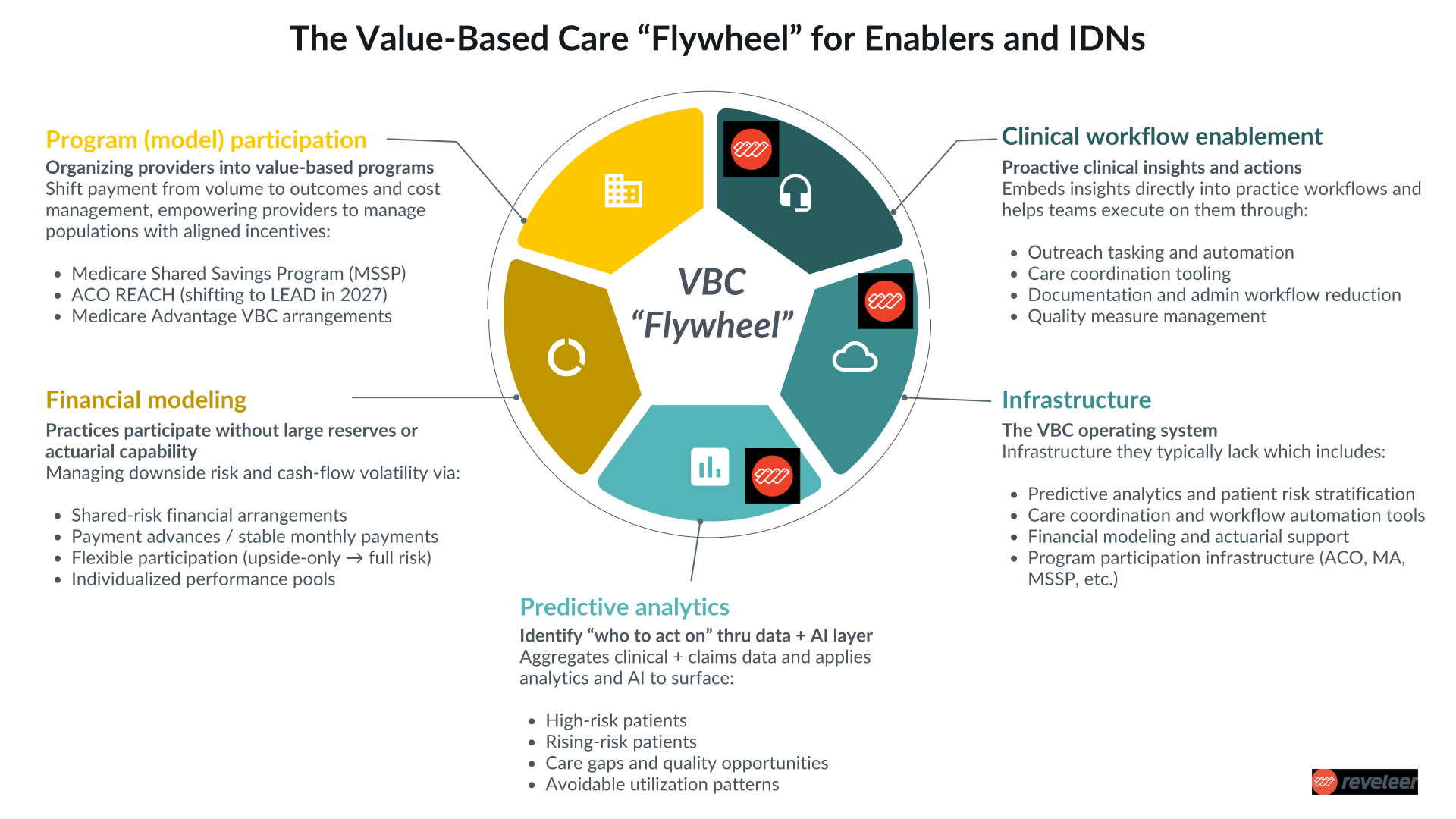
- Starting with program participation, organizing providers into value-based programs shifts payment from volume to outcomes and aligns incentives so providers can manage populations effectively. Sometimes this requires showcasing the ROI of value-based care over the long term. One attendee asked how to do this and make sure all leaders are on board with five-to-ten-year goals. We discussed how important it is that providers are in the right risk contracts so that they have a realistic path to incremental improvements. Leadership also must be grounded in the longitudinal nature of care. New CMS models are actually extending measurement horizons, making this perspective more widespread.
- Practices also need financial modeling to manage downside risk and smooth cash flow volatility. For many smaller provider organizations, financial sustainability is the condition for value-based care being viable at all. Shared-risk financial arrangements, payment-stable monthly payments, flexible participation, and individualized performance pools all factor into the viability within the provider group.
- From there, predictive analytics determine where to focus. Aggregating clinical and claims data allows organizations to identify which patients and opportunities deliver the highest value. The question shifts from "what happened?" to "who do we need to act on, and when?"
One attendee asked us if remote patient monitoring and DME data would be used as an input or output into predictive analytics. Pearl Health treats it as both. It can reveal risk and coding gaps and also feed predictive models. Real-world data feeds the value-based care flywheel and strengthens prospective risk and quality workflows through the same evidence extraction, enrichment, and recommendation systems.
This is where the right kind of AI, such as Reveleer Hybrid AI, creates an unmatched value for predictive tools. GenAI alone cannot deliver the control and transparency needed for reliable prospecting at scale. A hybrid AI approach, where large language models gather, validate, and store raw evidence as meaningful evidence objects while clinician-owned rules handle the reasoning that drives the recommendation, is what makes Reveleer AI insights trustworthy and defensible in this environment.
- The fourth component is infrastructure. Most practices need unified data ingestion, clinical intelligence, risk adjustment, quality improvement, and member management in a single system to really adopt value-based care in a way that doesn’t distract from providing care. Fragmented systems that only execute on part of the flywheel slow performance and compound provider abrasion. Adopting and embracing core technologies to deliver on that infrastructure allows providers to gain the benefit of an orchestrated and complete data to insights infrastructure that can and will expand patient longitudinal views for more advanced diagnostic insights without all of the headache.
- The fifth component of the flywheel is clinical workflow enablement. Data and AI only create value when they reach clinicians at the right moment and in the right place with the right level of actionable detail.
A participant asked how mid-market and heterogeneous provider groups can realistically adopt systems given varied EHRs and resources. We discussed the need for a risk adjustment engine with flexible native EHR integrations. This enables pre-visit insights that allow providers to arrive at the encounter prepared. Point-of-care delivery ensures those insights are available during the encounter, and, post-visit, AI can support coder review before claims submissions. Automation can free existing teams to focus on provider education instead of manual chart review, but technology must be simple at the point of care.
Throughout, analytics and reporting give payer-provider partnerships a shared view of progress on risk and quality gaps at each stage and comprehensively around the flywheel. The flywheel model shows the necessary components to achieve the new value equation. Investing in a comprehensive solution with key partners is what it will take to be successful. Better outcomes lead to lower costs, which generate shared savings, fuel provider revenue growth, and enable reinvestment in care capacity. The cycle is self-reinforcing, but only when the components are aligned.

Practical steps to align risk and quality teams
The RISE National session made one thing clear: risk adjustment and quality improvement can no longer operate as separate functions. The organizations that thrive with value-based care technology will be those that unify their data, embed AI with transparency and human oversight, and build workflows that empower clinicians to act on insights.
For organizations ready to move, the path forward starts with an honest assessment of where you stand today. From there, the priorities follow: unified infrastructure, explainable AI, and clinical intelligence embedded into the workflows your providers already use. The window to get ahead of these changes is open. Now is the time to align your teams and close the gap between risk and quality. Access a copy of the session slides for “The New Performance Equation: Risk x Quality = Value”.
Pearl Health and Reveleer: Partnering for better outcomes
Pearl Health is a technology provider and risk partner that helps primary care practices and ACOs thrive in value-based care. Pearl closes the gap between insight and action, combining AI-driven prioritization, EHR-embedded workflows, and contract strategy to put the right work in front of the right person at the right time. Today, Pearl supports 5,000+ providers managing 280,000+ patients and $3.4B in premiums across MSSP, ACO REACH/LEAD, and Medicare Advantage.
Reveleer is proud to partner with Pearl Health to bring clinical intelligence, prospective risk adjustment, and reporting capabilities directly to their network of providers. This integration brings suspect condition documentation, reconfirmation workflows, and point-of-care support to clinicians in the moments that matter most. It reinforces the core belief shared by both organizations: that closing documentation gaps and improving quality outcomes are not competing priorities, but compounding ones. Together, Reveleer and Pearl Health are helping providers turn the risk-quality equation into real, measurable value.
If you are a healthcare organization working with Pearl Health and would like to learn more about how Reveleer's solutions can support your team, we invite you to submit a demo request.

About the Author
Author Spotlight

Related Resources

The ROI of AI-enabled prospective risk adjustment
Learn how AI-enabled prospective risk adjustment drives better clinical outcomes, reduces costs, and improves value-based care.

Ethical AI in value-based care: Balancing innovation with trust and transparency
Watch the session, ‘Ethical AI in Value-Based Care’, to learn about Reveleer’s AI trust and transparency.

Simplifying HEDIS®: How intelligent automation gives you more time
Learn how intelligent automation accelerates HEDIS reporting, improves efficiency, and enhances data accuracy for healthcare organizations.

