
The hidden risks MA plans face after AEP
Learn how to improve Medicare Advantage performance after AEP by identifying hidden risks like data lags and attribution delays.




You enrolled the members. Now what?
The Medicare Advantage Annual Enrollment Period is officially behind us. Dashboards are populated, growth targets have been measured, and enrollment teams have taken well-earned victory laps or reviewed results when numbers fell short.
Now comes the next phase of questions, and it’s not about how many members were enrolled during the Annual Enrollment Period (AEP). Rather, plans should be asking what their new member population looks like. Which risks will cost us the most? What data is needed to get members the right care, at the right time. Which value-based care bets are about to pay off, and which ones aren’t?
These questions are critical to financial performance in Medicare Advantage (MAPD). And yet enrollment data alone cannot answer these questions. Focusing on topline membership growth often hides the very signals that determine financial performance for the rest of the year. These signals point to member risk levels and the critical care gaps that will shape cost, quality, and member experience.
For Medicare Advantage plans, February is not a rest period after AEP. It’s time to implement a more comprehensive and data-rich member management approach to increase visibility into plan performance.
Success during AEP does not equal performance success
Strong enrollment numbers often feel like important momentum for MAPD business. More members mean more revenue, broader reach, and proof of benefit design and broker strategy. Unfortunately, growth without insight can just as easily increase downside risk and surprise costs later in the year.
New members often arrive with higher acuity than expected. They often have incomplete clinical histories or care patterns misaligned with plan assumptions. Benefit designs that looked compelling during AEP may not translate into cost-effective utilization once members begin using the system. And value-based care arrangements that performed well last year may suddenly face a different risk mix that needs new attention and tactics.
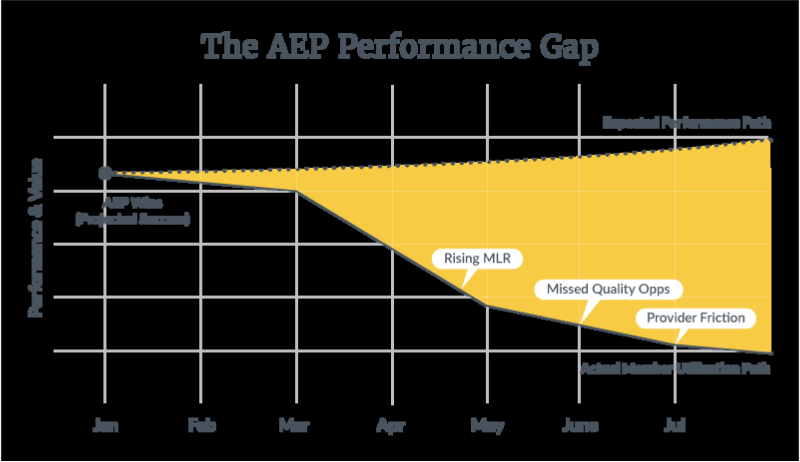
This creates a growing performance gap between the people who enrolled during AEP and how those members will actually use care across the first half of the year. That gap is where rising medical loss ratios (MLR), missed quality opportunities, and provider friction begin. These problems start long before they show up in year-end results. Plans that recognize and close this gap early are the ones that turn enrollment wins into true performance wins.
Where risk is hiding after AEP
Post-AEP risk rarely announces itself clearly. Instead, it hides in operational seams that widen in the early months of the year.
Data lags between enrollment, eligibility, claims, and care coordination delay a plan’s ability to understand who its members really are. Historical records can trickle in slowly or fail to arrive at all, leaving member profiles incomplete. Members may be misaligned to provider networks or unaware of benefits that could steer them toward more appropriate care that also costs less.
Meanwhile, internal teams are asking urgent questions:
- Which members should care management focus on now?
- Which contracts look different than we expected?
- Where are we already off-track versus our actuarial assumptions?
Waiting for full-year claims data or Stars performance means discovering these problems far too late for meaningful interventions. Plans need ways to see these patterns in weeks and months, not at the end of the year.
How value-based care arrangements suffer early on
Post-AEP data challenges can often jeopardize the success value-based care contracts in the first two quarters of the year. First, attribution delays can leave payors unsure which members are actually on their plans. Even if they have up-to-date member files, they may also not have full visibility into their new members’ risk profiles. As a result, the most high-risk members may remain under-engaged during the critical early months when preventive outreach and documentation matter most.
For plans, these early gaps do not always trigger immediate alarms. Instead, they quietly lock in medical loss, hide quality opportunities, and create operational strain as teams scramble to catch up. By the time these issues surface later in the year, the opportunity to course-correct has largely passed.
Many value-based care failures are not driven by poor contract design, but by lack of early, actionable insight into member reality and what actions will change outcomes.
Tracking the early warning signals of hidden risk: 4 key signals
Discrepancies between enrollment assumptions and early utilization trends often signal deeper structural issues that will compound over time. The good news is that tracking performance of MA contracts can happen early on to avoid trouble later in the year.

1. High-cost utilization patterns

2. Low engagement among targeted high-risk cohorts

3. Unresolved attribution disputes

4. Gaps between expected versus actual risk mix
These signals live in the intersection of enrollment, eligibility, and member analytics—not in end-of-year reports, and advanced member management solutions can help track these metrics year-round. Plans that focus on them early can still influence outcomes by shifting resources, outreach, and care pathways before patterns are locked in.
Quickly pivoting from reflection to intervention
February marks the pivot from asking, What did AEP deliver? to answering, How do we ensure success in our value-based care performance this year?
This is the window when plans can still intervene, taking these critical steps to prioritize performance:
- Correct gaps in attribution data
- Ensure comprehensive member profiles
- Align care management resources
- Prioritize outreach to high-risk cohorts
Taking these steps requires more than static reports. It requires member management technology that unifies disparate member data, updates insights as new information arrives, and surfaces actionable opportunities in near real time. Without that technological foundation, even well-intentioned interventions are ineffective or too slow to matter
Looking ahead: Finding success in AEP and beyond
February is the perfect time to begin implementing the infrastructure necessary to truly understand member risk and support quality improvement, and it goes a long way to building the foundation for stronger AEP readiness. As MA plans conduct member management vendor evaluations than shopping for point solutions, they should define requirements rooted in real performance pain points and measure vendors on their ability to improve those metrics quickly.
Consider vendors whose capabilities include:
- A unified member view across enrollment, eligibility, and clinical data
- Analytics that operate in near real time
- The ability to operationalize insights quickly across engagement, care management, and value-based care workflows
Reveleer Member Management can set plans up for success in AEP and value-based care performance overall. Plans using Reveler gain outcomes like:
- A unified, trustworthy view of who was actually enrolled and what risk they carry
- Accurate eligibility, compliance, and member alignment that reduce downstream friction
- Targeted, timely insights into prioritized outreach to activate high-risk members early
- Increased operational efficiency to control costs
Together, these outcomes answer the questions enrollment numbers alone cannot: Who did we really enroll? Where is risk concentrated? And how do we change the cost and experience trajectory before it’s too late?
MA plans cannot change who they enrolled during AEP. But they can still meaningfully change how expensive and how satisfied those members will be in PY26.
February is not a waiting period. It is the earliest and most powerful opportunity to shape performance. Now is the time to stand up the member management and analytics capabilities that turn enrollment into sustainable performance.

About the Author
Related Resources

The ROI of AI-enabled prospective risk adjustment
Learn how AI-enabled prospective risk adjustment drives better clinical outcomes, reduces costs, and improves value-based care.

Ethical AI in value-based care: Balancing innovation with trust and transparency
Watch the session, ‘Ethical AI in Value-Based Care’, to learn about Reveleer’s AI trust and transparency.

Simplifying HEDIS®: How intelligent automation gives you more time
Learn how intelligent automation accelerates HEDIS reporting, improves efficiency, and enhances data accuracy for healthcare organizations.

