
CMS finalized its 2027 Star Ratings overhaul, cutting eleven measures and elevating HEDIS
Get the latest on CMS’s CY 2027 final rule impact on quality measures and how plans using evidence-linked AI will be ahead of the curve.




Originally published February 2, 2026. Updated May 2026 to reflect the CY 2027 final rule issued April 2, 2026.
On April 2, 2026, CMS issued the Contract Year 2027 final rule governing Medicare Advantage Star Ratings, following the proposed rule analyzed in our February assessment. The final rule preserved the digital, outcomes-first orientation of the proposal but departed from it in three respects. It removed 11 of the 12 measures proposed for elimination, applied to Medicare Advantage contracts effective January 1, 2027, and declined to adopt one equity-focused mechanism the proposal had included.
Key differences between the proposed and final CMS Star Ratings rule
1. Eleven of the twelve proposed removals were finalized. CMS finalized the removal of 11 Star Ratings measures, retaining Diabetes Care, Eye Exam, in response to targeted, clinical-evidence comments. Removals are concentrated in administrative process and low-differentiation categories, phased across 2028 and 2029.
The table below lists each removed measure with its program, the Star year the removal takes effect, and the reason CMS gave. Most fall under low variation or administrative process, phased across 2028 and 2029.
Source: CMS CY 2027 MA and Part D Final Rule, April 2, 2026. Removed measures continue to appear in CMS online plan comparison tools. CAHPS survey questions for Customer Service, Complaints, and Disenrollment remain for monitoring.
Note: Diabetes Care, Eye Exam (Part C) was proposed for removal but retained following clinical evidence comments demonstrating contract-level variation and measurable patient impact.
2. HEDIS becomes the primary Star Ratings driver. Starting in 2029, HEDIS clinical measures will have the greatest relative influence on overall ratings. Plans that sustained performance through administrative measures lose the buffer that once absorbed clinical underperformance.
3. A new Part C measure is added, Depression Screening and Follow-Up. This new measure will be effective in the 2027 measurement year. Quality teams still building depression screening into prospective gap closure workflows should act before the measurement window opens.
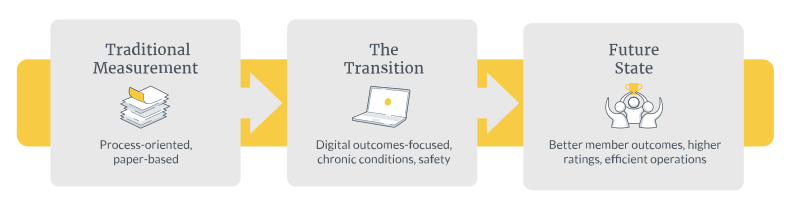
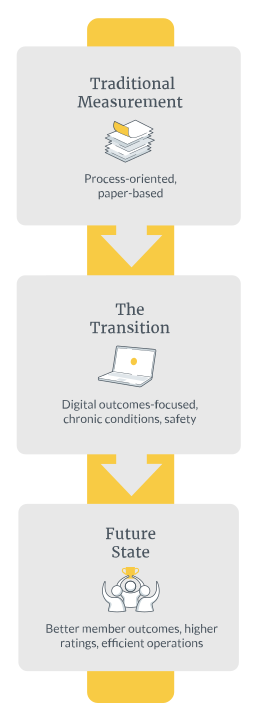
4. The Health Equity Index reward is set aside. CMS did not adopt the Excellent Health Outcomes for All reward and retained the historical reward factor. Plans that built a strategy around the equity reward need to recalibrate. Under the final rule, Medicare quality measurement turns sharply more digital and outcomes-focused in 2029. It centers on chronic conditions, patient safety, and timely follow-up on abnormal results. Keeping up means modernizing data, workflows, and provider engagement, so plans can perform on clinical outcomes, hold their Star Ratings, and protect Quality Bonus Payment revenue.
Process compliance no longer protects ratings
For Medicare Advantage plans and other risk-bearing organizations, CMS is moving the pressure from process compliance to harder clinical outcomes. And as CMS leans digital-first, fragmented, manual record workflows turn into a growing liability. Continuous, digital quality improvement is now the baseline. Plans have to perform on clinical outcomes across the whole measurement year, not just clean up the record in an audit before submission.
Continuous quality programs depend on systems that trace where each record came from, keep abstraction auditable, and keep a person in the review loop. That combination lets quality leaders check every measure result against the clinical record behind it. When quality and risk adjustment draw on the same retrieval and abstraction infrastructure, plans avoid duplicate work and build more complete patient records. That foundation improves performance on the harder Medicare measures, the ones tied to chronic disease and post-acute care.
Financial consequences of the changes to quality ratings
CMS has estimated that the Star Ratings changes produce a net impact of $18.56 billion on the Medicare Trust Fund from 2027 through 2036, representing 0.21% of total Medicare payments to private health plans over that period. Press Ganey analysis found that 89% of MA contracts would see their Star scores decline if the changes were applied to 2026 results, with an estimated $1.3 billion in Quality Bonus Payment dollars at risk.
Plans that leaned on strong administrative process scores face tighter Quality Bonus Payments beginning in 2027. The checkpoints those measures tracked, such as claims processing speed, call center responsiveness, and enrollment accuracy, no longer earn Star credit. CMS still audits and monitors them.
The evolution of CMS's focus on quality measures
Reveleer in a digital, outcomes-first program
Reveleer’s Quality Improvement Solution supports risk-bearing organizations in meeting HEDIS® compliance and applies the same infrastructure to year-round measure management. The Reveleer Platform brings retrieval, abstraction, and clinical quality workflows together, so plans can capture more measures across both digital and traditional data sources. In documented deployments, abstraction efficiency improved by as much as 75 percent, with an average accuracy rate of 88 percent on priority measures.
Care Gap Manager provides continuous oversight of open care gaps across HEDIS and Part C measure programs throughout the measurement year. Quality teams and provider groups can then address gaps such as overdue mammogram follow-up or colorectal cancer screening earlier in the cycle, rather than at its close. Providers can review open gaps, submit supporting evidence, and track prior submissions as they go. High-impact gaps close more reliably, and performance shifts toward clinical outcomes rather than process.
Reveleer Quality Improvement is HEDIS engine-agnostic, integrating quickly with existing engines or internal systems, making it easier for payers to align with CMS’s digital interoperability priorities. Reveleer documents double-digit improvements in chronic condition management, higher retrieval rates, and measurable revenue gains. Organizations on this infrastructure are better positioned to sustain Star Ratings and protect Quality Bonus Payment revenue under the final rule.

Frequently asked questions
What new quality measure did the CY 2027 final rule add?
The final rule adds Depression Screening and Follow-Up (Part C), effective in the 2027 measurement year. It reflects CMS's broader shift toward clinical outcomes, chronic conditions, and digital data over administrative process measures.
How does the CY 2027 final rule affect Medicare Advantage plans?
It removes 11 Star Ratings measures, makes HEDIS clinical measures the primary ratings driver starting in 2029, and makes fragmented, manual record workflows a liability.
How should Medicare Advantage plans prepare their quality programs for the 2027 measurement year?
Plans need to close care gaps continuously throughout the measurement year rather than concentrating effort in the final weeks before HEDIS submission. With administrative process measures exiting Star Ratings and clinical outcome measures carrying greater weight, only continuous measurement protects against Quality Bonus Payment risk. Quality teams should assess depression screening workflows now, given the new Part C measure takes effect with the 2027 measurement year.
What does the shift to HEDIS-weighted Star Ratings mean for health plan technology strategy?
Plans that relied on seasonal, HEDIS-only programs face compressing margins as clinical outcome measures now determine the majority of Star Ratings results. Year-round gap closure, continuous clinical data retrieval, and integrated abstraction workflows have become core infrastructure investments. Plans still operating on annual cycles need to evaluate whether their current technology can support prospective quality improvement across the full measurement year.
How does Reveleer support health plans navigating the CY 2027 Star Ratings changes?
Reveleer connects clinical data retrieval, care gap identification, and HEDIS® abstraction in one platform, giving quality teams continuous visibility into measure performance rather than a point-in-time view at submission. The platform is HEDIS engine-agnostic, integrating with existing engines or internal systems while leaving current technology in place.

About the Author
Related Resources

The ROI of AI-enabled prospective risk adjustment
Learn how AI-enabled prospective risk adjustment drives better clinical outcomes, reduces costs, and improves value-based care.

Ethical AI in value-based care: Balancing innovation with trust and transparency
Watch the session, ‘Ethical AI in Value-Based Care’, to learn about Reveleer’s AI trust and transparency.

Simplifying HEDIS®: How intelligent automation gives you more time
Learn how intelligent automation accelerates HEDIS reporting, improves efficiency, and enhances data accuracy for healthcare organizations.

