Turn every encounter into a prospective risk opportunity
Evidence-based insights healthcare providers can trust
Reveleer Prospective Risk Adjustment delivers the insights you need to close diagnosis and care gaps at every point along the patient encounter lifecycle. The result is improved documentation accuracy, stronger quality performance, and audit-ready documentation that fits how teams already work.

Actionable insights before, during, and after visits
Prospective Risk Adjustment supports CDI pre-visit review, point-of-care insights, and post-visit pre-bill checks. Each encounter becomes a chance to address diagnosis gaps and care gaps in real time instead of chasing issues months later.

From black-box scores to clinically meaningful opportunities
Where traditional NLP tools rely on vague probability bands, Reveleer EVETM Hybrid AI starts with clinical authority: 11,000 clinical indicators turn chart noise into a short list of high-value suspects that carry clear, defensible proof.
How Prospective Risk Adjustment changes the visit
See how Reveleer Prospective Risk Adjustment surfaces diagnosis gaps and care gaps in your EHR so providers work from the same evidence-backed view of each patient, with fewer interruptions and more clinically meaningful insights.
How It Works
Prospective Risk Adjustment that keeps providers in their flow
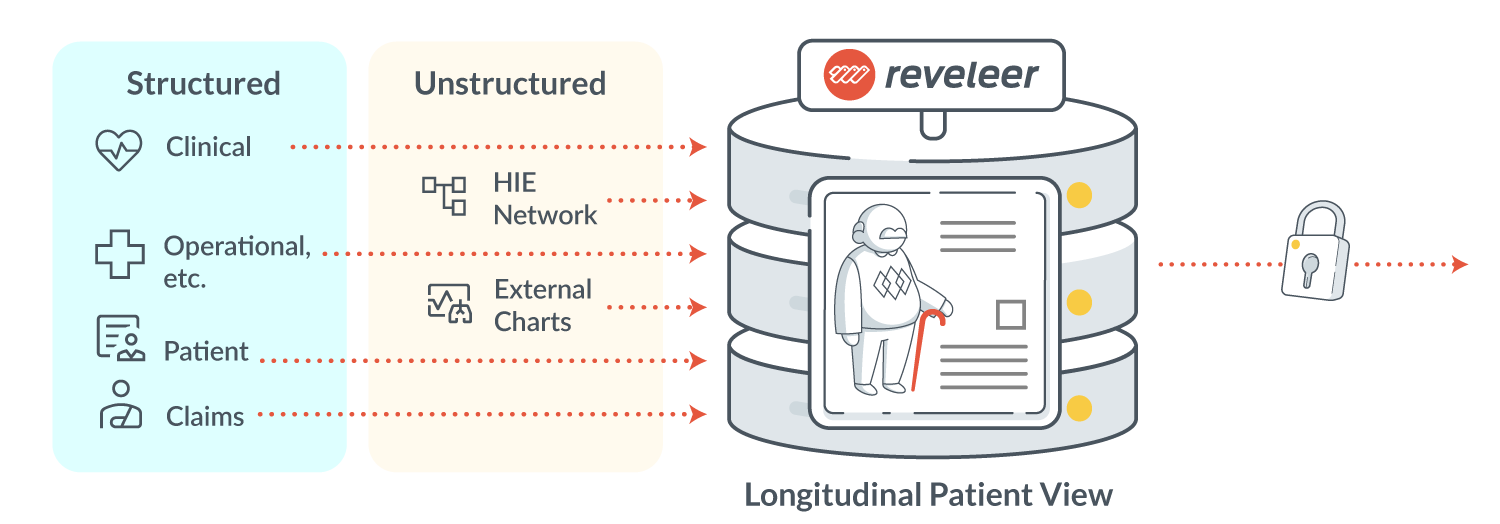
Unify claims and clinical data
Reveleer ingests structured and unstructured data from EHRs, HIEs, labs, claims, and specialty networks to build a longitudinal patient record.
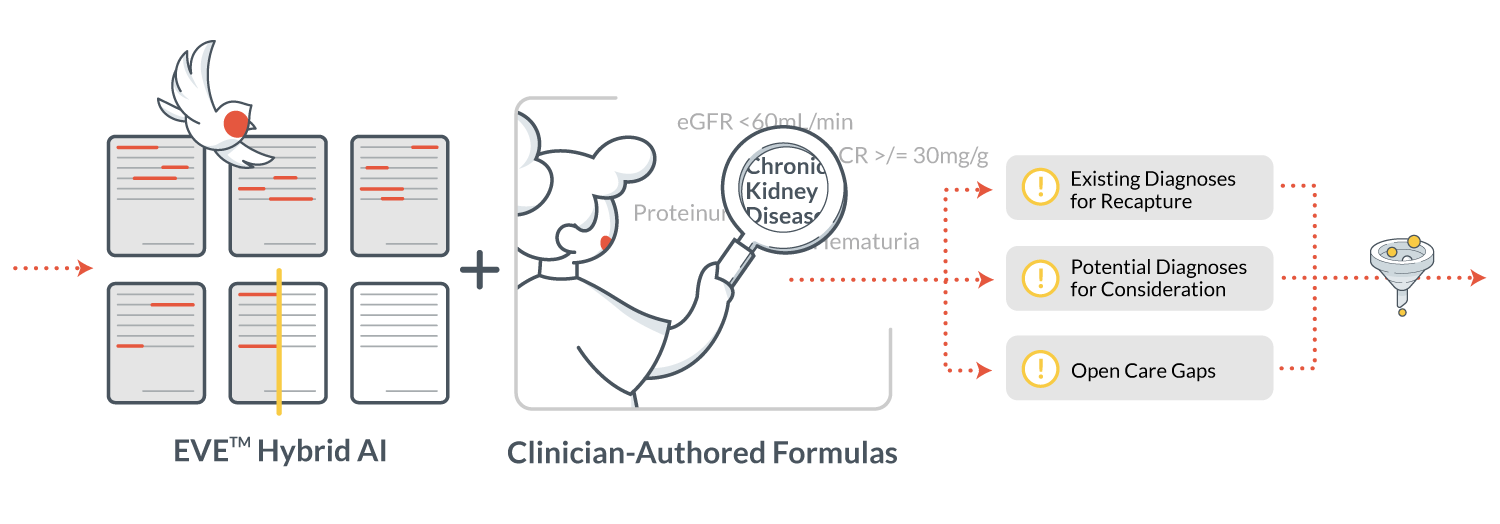
Find high-value opportunities
EVE TM Hybrid AI extracts evidence from charts. Clinician-authored formulas then determine conditions that qualify as potential recapture, net new diagnoses, or open care gaps.
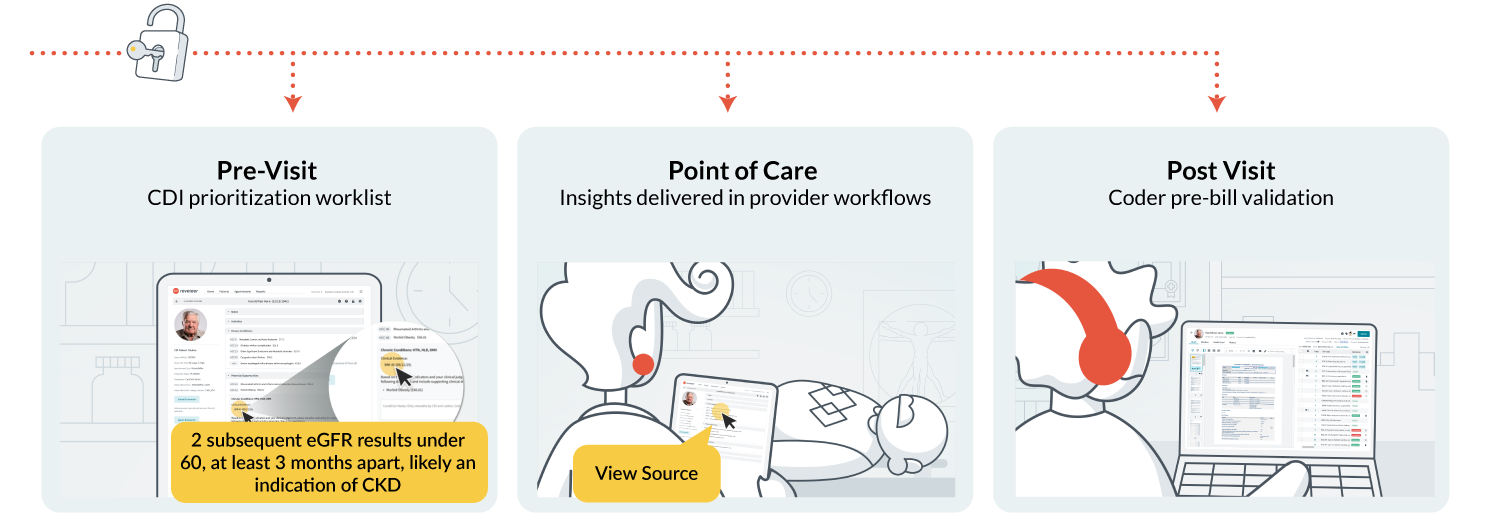
Deliver insights directly in your workflows
CDI teams review prioritized worklists to close diagnosis and care gaps before, during, and after the visit, all supported by advanced analytics.
Real-time prospective risk drives measurable financial and clinical impact
Achieve better value-based care performance by addressing diagnosis and care gaps during point-of-care visits with Reveleer Prospective Risk Adjustment.

6X ROI and $18.5M in enhanced revenue capture
A large not-for-profit health system used Reveleer’s point-of-care suspecting to improve its suspect HCC provider address rate by 34 percent in one year, generating a 6X return on investment and $18.5 million in additional revenue capture.

3X less noise than traditional NLP suspecting
Benchmarks of EVE Hybrid AI includes up to 3X less suspect “noise” for providers than legacy NLP workflows, with every recommendation tied to explicit source evidence and transparent logic.

55% increase in HCC capture per patient
By combining AI and CDI resources, health systems experience a significant increase in efficiency, making the best use of highly constrained staff time.
%20-%20Standing.avif)

Prospective risk, reimagined
Drowning in false positives and black-box suspects? With EVE™ Hybrid AI powering Prospective Risk Adjustment, noise drops by up to 3X vs. legacy NLP, so clinicians and coding teams can focus on the most relevant, evidence-backed suspects tied to clear, traceable source documentation. Get a demo to watch suspects flow through an audit-ready evidence graph and turn “why is this flagged?” into fast, defensible action.
Prospective Risk Adjustment software that works for providers
Multi-model, multi-EHR support
Reveleer supports CMS V28, HHS V08, and other key models and integrates with Epic, athenahealth, and more. Portals, overlays, and data exhaust mean your teams see information when and where they need it.
Visit-aligned advisories for CDI, providers, and coders
Support CDI pre-visit review, provider point-of-care advisories, and coder pre-bill checks with one consistent set of evidence-backed insights. Improve documentation quality and reduce rework for busy care teams.

Analytics from enterprise to encounter
Track RAF projections, suspect performance, and provider engagement with executive, network, and operational dashboards. Easily identify what is working and where to intervene.
See Prospective Risk Adjustment in action
Meet with our team to see how Reveleer Prospective Risk Adjustment fits into your Epic, athenahealth, or other EHR workflows, and how EVE™ Hybrid AI can reduce noise while driving measurable risk quality improvements this performance year.
- Discuss your value-based contracts and current risk workflows.
- Walk through CDI, provider, and coder use cases.
- Explore analytics, reporting, and implementation options.
Request a demo
The basics of Prospective Risk Adjustment
What is Prospective Risk Adjustment and how is it different from retrospective risk adjustment?
Prospective Risk Adjustment helps risk-bearing organizations surface diagnosis gaps at the point of care to proactively address gaps in care and improve patient outcomes. Retrospective programs rely on post-claim reviews that can result in administrative burden and missed opportunities. Prospective Risk Adjustment can supplement retrospective audits by delivering an accurate picture of patient health well ahead of retrospective deadlines.
How does Reveleer AI technology reduce alert fatigue for providers?
EVE Hybrid AI separates evidence extraction from clinical decision-making and uses clinician-owned formulas plus specialty-specific logic, which significantly reduces noise and focuses advisories on high-value, clinically relevant opportunities.
What types of clinical information appear in provider insights?
Insights may include existing diagnoses for recapture, potential diagnoses for consideration, and open care gaps, each backed by specific clinical indicators and clear next steps.
How does Prospective Risk Adjustment support audit readiness?
Every suspect and gap is linked to its source documentation and the formulas that generated it, creating a transparent, traceable record that aligns with AHIMA and ACDIS guidance for compliant queries.
Which risk models and lines of business are supported by Reveleer?
Reveleer supports CMS V28 and additional models such as HHS V08 and Medicaid CDPS Rx, with coverage expanding over time to support key value-based contracts across Medicare Advantage, ACA, Medicaid, and Commercial.
How long does Reveleer Prospective Risk Adjustment implementation typically take?
Depending on data readiness and delivery method, prospective risk programs can go live in as little as six to twelve weeks after production data is available, with options for portal access, direct EHR integration, or overlays.
How does Reveleer keep prospective risk programs current when CMS or HHS risk models change?
When CMS or HHS models change, clinical rules can be updated in days rather than months, without retraining AI models, so suspecting stays current while your teams stay focused on patient care instead of rule rewrites.
Related Resources
Explore the latest on how AI-enabled prospective risk drives improved outcomes and time-saving efficiency for value-based healthcare organizations.

The ROI of AI-enabled prospective risk adjustment
Learn how AI-enabled prospective risk adjustment drives better clinical outcomes, reduces costs, and improves value-based care.

Ethical AI in value-based care: Balancing innovation with trust and transparency
Watch the session, ‘Ethical AI in Value-Based Care’, to learn about Reveleer’s AI trust and transparency.

Simplifying HEDIS®: How intelligent automation gives you more time
Learn how intelligent automation accelerates HEDIS reporting, improves efficiency, and enhances data accuracy for healthcare organizations.

